Introduction: Why Transparency Matters in Programmatic Advertising
The creation of Programmatic Advertising started out not having full Transparency of the process. Initially when it was created Publishers relied primarily on the Waterfall Auction Model. The Waterfall Auction Model operated by calling Ad Networks in linear order until the inventory was sold. This made it easy for Publishers to get the Ads they were paid to deliver, however, Publishers had little to no insight into actual pricing or Buyers were willing to pay. For the sake of simplicity and ease of use, many Publishers sold their Inventory at less-than-optimal rate because higher valued demand was never provided the opportunity to compete.
The limitations of Waterfall as a result became evident over time. Many Publishers struggled with having limited visibility into actual Bid Pricing making it difficult to ascertain what true market demand is. As a result, Pricing Inefficiency became the norm, with Impressions being sold or under/overpriced because they were undervalued or not sold at all. Increase reliance on a single Ad Exchange Limited a Publisher’s ability to negotiate and concentrated the Publisher’s Risk on a single Exchange, particularly after Platforms started prioritizing their own Demand Sources.
As programmatic advertising became more established, publishers were searching for ways to resume control of their inventory. The outcome was that header bidding became widely known as a process whereby multiple buyers could bid on the same inventory (i.e. impression or ad) at the same time before the ad server chose the winner. Publishers were now able to look at competing bids next to one another and therefore they had greater transparency and increased competition. The success of header bidding led to a more even playing field where an impression goes to the highest bidder, rather than just the next network in line.
Transparency and competition now are essential elements for driving publisher revenue. Publishers who have access to real-time bid data can make smarter pricing decisions and diversify their demand away from any one platform.
This evolution of the header bidding marketplace set the stage for the creation of Prebid, today’s most popular open-source header bidding solution, which was developed and created by publishers and is built to provide publishers with tools for more equal auctions, better insights and increased control over how they monetize their inventory. When paired with a professional ad management platform, this shift toward transparent auctions allows publishers to turn complex programmatic mechanics into consistent, scalable revenue.
What Is Prebid?
As an open-source header bidding wrapper, Prebid allows you to engage in real-time bidding (RTB) across several different advertisers prior to making an actual ad call. This means that multiple advertisers are able to submit bids for a single impression simultaneously; therefore, the highest bidder will receive the impression.
Prebid differs from previous models where advertisers could only participate in auction processes one at a time. By utilizing a unified auction format, all participating advertisers are now viewed within one auction. This creates new opportunities for publishers to see how their impressions are selling, ultimately giving them more insight into their available inventory, as well as giving them greater control over their monetization results.
What Prebid Does
In essence, Prebid strives to create a level playing field between advertisers and publishers through transparency in the bidding process. The mechanics of Prebid include the following:
- All participating SSPs are invited to place bids simultaneously (as opposed to sequentially).
- Based on these bids received, the highest value bid will be determined on an impression-by-impression basis and provided in real-time.
- The winning bid will be passed to the ad server (e.g., Google Ad Manager) where it will compete with other eligible demand sources.
- All demand partners will compete fairly, with no partner receiving preferential treatment.
By following these basic mechanics, publishers can find the true market value of their inventory and eliminate revenue lost through mismanaged auction processes.
What Is Prebid Not?
While the focus of Prebid is to empower publishers with greater revenue opportunities, it’s just as important to know what Prebid does not provide:
- Prebid does not serve as an intermediary between buyers and sellers.
- There is no one company that owns Prebid.
- Prebid is not a proprietary closed ecosystem, preventing publishers from adding or removing demand partners from the Prebid platform.
Rather, Prebid is technology-neutral, so publishers are empowered as opposed to being reliant on a single intermediary.
Prebid Implementations
The implementation of Prebid may be accomplished via two main avenues:
- Prebid.js is a browser or client side solution that allows for running of auctions on a user’s device directly
- Prebid Server is a server based solution that moves the act of auctioning off the device &/or browser to decrease latency & increase performance.
The industry has included multiple names for the initiative : Prebid, pre-bid, pre bidding, pre-bidding, all of which are essentially the same initiative to provide opportunities through a fair, simultaneous manner to auction off ad placements prior to decision-making about those placements by ad servers.
How Does Prebid Work?
In order to fully appreciate the true potential of Prebid, it is important to understand the various stages involved in running a pre-bidding auction from the time a user arrives at the site to when they see the ad. Although this occurs in a matter of milliseconds, every step along this process serves a critical purpose in providing a fair, price-driven competitive auctioning process.
Step 1: The Prebid Wrapper Loads
The Prebid wrapper loads in the page header at the time a user visits the site, prior to any call being made to the ad server. The wrapper will have the auction functionality that includes:
- Which ad units can be bid on
- The demand partners (SSPs or exchanges) that can bid
- What the floor prices, timeouts, or other rules will be for the auction.
By loading the auction logic as early as possible, Prebid provides demand partners with the first opportunity to compete for the impression.
Step 2: Bid Requests Are Sent Out
The Prebid will then create and send bid requests to all enabled demand partners at the same time after the wrapper has been initialized. Demand partners will independently evaluate each impression based on the following:
- User signal and context
- Placement & format of the ad
- Past performance of each partner, using historical data to predict who would win the auction
In contrast to waterfall setups, there is no priority associated with where a demand partner is located in the chain of bidders-every demand partner has an equal opportunity to compete for every impression at the same time.
Step 3: Bids Are Returned
Demand partners place their bids using different types of information. A sample of some of the information in the bid would consist of:
- The Bid Amount (CPM)
- Creative Details for the Ad
- Targeting Data used by The Ad Server
Prebid has strict timing requirements to protect the performance of web page views. If there is no response from the bidder within the timeframe stated by Prebid, then the bidder’s bid will not appear in the auction selection.
Step 4: The Highest Valid Bid is Selected.
Prebid collects the valid bids and selects the highest eligible bid from the response. The selected bid is what will go to the ad server along with the associated targeting key/values. Prebid’s selection process is based only on eligibility and the amount of the selected bid, not on any previously agreed upon priorities or relationships.
Step 5: The Ad Server Makes A Decision.
The ad server (such as Google Ad Manager) will look at the winning bid received from Prebid along with any direct-sold campaigns and programmatic purchases that were made through other demand sources. Ultimately, the highest-performing ad that meets the qualifications will appear on the web page view.
A major takeaway to be aware of is that Prebid doesn’t use a priority-based model to select which ad will run on a web page. Prebid uses a price mechanism, and therefore, assures publishers capture every impression at the actual value of the impression.
Key Components of Prebid
The modular nature of Prebid’s flexibility; by allowing publishers to compose, scale and configure their systems in accordance with scale, goals and privacy requirements; is critical to the success of any pre-bid set up, the components of which need to be understood to fully optimise that set up.
Web browsers are used to run auctions with the Prebid.js framework (www.prebid.org) and therefore, this is the most widely used implementation of Prebid as it enables the publisher to run their actions directly in users’ browsers.
With auctions being run client-side, it gives publishers greater transparency to bid response and pricing.
Publishers have quicker access to cookies, first-party data and user IDs via their client-side implementations, thus improving quality of bids.
In addition, publishers have direct access to very granular data on their bid levels for debugging or optimization purposes.
The downside to running too many bidders’ client-side is that in many instances, it can lead to increased latency for web pages. If there are no bidder limits or timeouts, consumer experience can suffer when browsers run more than one auction in a given auction.
Prebid Server (Server-Side Bidding)
The auction logic for Prebid Server (Server-side bidding) is managed and performed on external servers, rather than the browser. This means that it can reduce the amount of resources the browser uses, thus speeding up page loading time. Because of the efficiency with which Prebid Server scales to accommodate large numbers of demand partners, centralized auctions make it easier for high-traffic publishers to build their infrastructure around a single auctioning platform.
However, since some bid-level details and user signals may be available to clients when using Prebid Server rather than client-side solutions, there exists a slight reduction in breadth and depth of transparency. Publishers can use a hybrid approach (utilizing both client-side and server-side bidding) to increase their transparency and bid-level detail.
Adapters are used to connect Prebid with individual demand partners such as SSPs and Exchanges. Each adapter determines how to process bid requests and responses from each demand partner.
Publishers have complete control over:
- Which bidders may participate
- Bid timeout and auction priorities
- Price floors, currency rules and Deal IDs
Thus, by allowing publishers to complete fine-tune competition without being tied to any single buyer, publishers can create the best competitive environment for their business..
Analytics Modules
Prebid includes optional analytics modules that provide visibility into auction performance. These modules track:
- CPM trends and bid distributions
- Win rates by bidder
- Bid response times and latency
This data enables smarter yield optimization and performance tuning.
User ID Modules
In a privacy-first ecosystem, User ID modules support multiple identity solutions. These help improve addressability, maintain demand competition, and reduce revenue loss as third-party cookies decline.
Benefits of Using Prebid for Publishers
The Prebid system is much more than just a technical upgrade; it completely alters how the publisher, or ad inventory owner, controls the bidding process. With Prebid’s introduction of Pre-Bidding, publishers now have a clear path towards revenue improvement and minimization of their operational problems by having a way to address longstanding problem areas.
Transparency – Full Transparency is a primary benefit of using the Prebid platform.
- Publishers have complete transparency into the bidding process; they can see all the bid amounts that come in as opposed to just seeing which of those amounts received the winning bid.
- The ability to analyze buyer behaviors across multiple SSPs and ad formats has never before been so accessible.
- Publishers can easily and quickly identify partners that are slow to perform or underperforming and either make optimizations to the way that partner is delivering impressions or remove them entirely.
This level of insight into who is participating in the auction enables publishers to use data-driven decision-making practices rather than relying on platforms that provide no transparency into their decisions.
Increased Competition – The introduction of Prebid creates a competitive atmosphere where all bidders are participating in the bidding process simultaneously for each impression.
- There is no longer an artificial advantage given to any specific bidder.
- Bidder demand sources are only competing on price and eligibility for a particular impression.
- Fair bidding practices will naturally create upward pressure on CPMs.
For many publishers, the resultant increase in competition from Prebid has led to improvements in yield and consistent revenue performance.
Improved Control Over the Monetization of Inventory with Prebid Technology
The Prebid platform enables publishers’ greater control over how they sell their inventory.
- The publisher decides how their auction logic, bidder access, and timeout settings will work within the technology.
- There is no requirement for one exchange to be placed higher than any other exchange.
- Publishers can see the entire demand stack of all advertisers. This allows them to have less reliance on one single platform and gives them the opportunity to create a more resilient monetization strategy.
Flexibility Across Multiple Ad Formats
Prebid is not restricted to standard display ads. Prebid can be used with various ad formats that include:
- Display
- Video (in-stream and out-stream)
- Mobile Web and Applications
- Native Advertising
Because Prebid can be utilized across all types of inventories, it gives publishers a consistent approach to action and creating a revenue-generating strategy.
Ongoing Development and Innovation through Open Source
Prebid is an open-source product, which means that its development is ongoing and driven by the development of the industry and the community behind it.
- It will allow publishers to be able to implement new industry standards and privacy laws rapidly.
- There is no chance of vendor lock-in.
- Because the community of publishers will drive the development of Prebid through their real-world needs, this means that innovations are developed based on what works for publishers, and not solely on what is best for one company.
The overall theme of Prebid is that it has given publishers back the power to control the negotiation process by allowing them to use transparent, competitive auctions for their inventory and maximizing revenue potential over the long term.
Prebid vs Waterfall vs Exchange Bidding (EBDA)
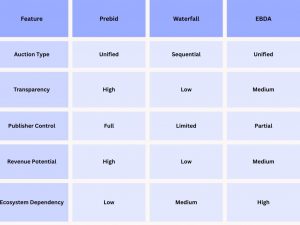
To understand why Prebid has become so important for modern publishers, it helps to compare it with the two other major auction models used in programmatic advertising: waterfall auctions and exchange bidding (EBDA). While all three aim to sell impressions programmatically, they differ significantly in transparency, control, and revenue outcomes.
Interpretation and Practical Impact
Waterfall auctions were the industry’s starting point, but they are fundamentally inefficient by today’s standards. Demand partners are called one after another based on a predefined order, not on how much they’re willing to pay. This means:
- Higher-value bids may never get a chance to compete
- Pricing decisions are based on assumptions, not real demand
- Publishers have limited visibility into true market value
In short, waterfalls prioritize order over value, which often leads to lost revenue.
Exchange bidding (EBDA) improves on the waterfall model by introducing a unified auction, but it operates within a single ecosystem-most commonly Google’s. While EBDA allows some level of competition, publishers:
- Have only partial control over auction mechanics
- Face limited transparency compared to open pre-bidding
- Become more dependent on one dominant platform for demand access
This ecosystem dependency can restrict flexibility and long-term bargaining power.
Prebid, by contrast, is designed to be neutral and independent. It enables a unified auction across multiple demand sources, regardless of platform ownership. Publishers retain:
- Full control over which partners can bid
- Complete visibility into bid values and performance
- The freedom to optimize without favoring a single exchange
Because Prebid is open-source and ecosystem-agnostic, it consistently delivers higher revenue potential and lower platform dependency.
Bottom line:
Waterfalls optimize for simplicity, EBDA optimizes within one ecosystem, but Prebid optimizes for fair competition, transparency, and publisher independence-making it the most future-proof option for serious monetization strategies.
Challenges and Limitations of Prebid
While Prebid offers clear advantages in transparency and revenue potential, it is not a “set it and forget it” solution. Like any open and flexible framework, it comes with challenges that publishers must actively manage to realize its full value.
Common Challenges
A major barrier frequently cited by publishers is the extensive technical set-up that must occur prior to beginning to use Prebid. The implementation of Prebid requires development time/resources to set up advertising units, configure adapters, integrate new bidders, and to target advertising accurately through the associated ad-server. Therefore, if a publisher has a small development team, setting Prebid up will be more resource-intensive upfront than if done with a larger team.
Another major barrier identified is client-side latency due to the nature of the Prebid.js auction running inside the browser. Therefore, increasing the number of bidders or having an excessive timeout value set up will directly increase load time for your page(s). For example, examples of poor optimization (e.g., excessive bidder timeout values, etc.) will negatively impact Core Web Vitals and overall user experience.
Publishers also have the requirement of continuously managing their bidder relationships and operations after going live with Prebid. Demand partners have varying success rates, and the performance of bidders can change due to fluctuations in demand, changes in privacy regulations, or schedule changes in the marketplace. If publishers do not monitor the performance of their bidders regularly, it could create a significant drop in overall efficiency.
Prebid also demands consistent optimization in the areas of floor price, bidders included, timeout values, auction logic, etc. These types of adjustments must be made continuously to ensure market dynamics are properly reflected in the manner of Prebid setup.
Why These Challenges Exist
These limitations are largely a byproduct of Prebid’s strengths. As an open framework, Prebid gives publishers full control-but that control requires active decision-making. Additionally, more bidders naturally increase complexity, both technically and operationally, especially when balancing performance against revenue.
How Publishers Mitigate Them
Experienced publishers address these challenges through smart architecture and process:
- Adopting server-side or hybrid Prebid setups to reduce browser load
- Enforcing strict bidder timeouts to protect page performance
- Conducting regular analytics reviews to remove low-value bidders and refine auction rules
When managed correctly, these limitations become manageable trade-offs rather than blockers-allowing publishers to unlock Prebid’s full revenue potential without sacrificing performance.
How to Optimise Prebid Performance
Optimizing Prebid is about striking the right balance between revenue, performance, and user experience. Without a structured approach, even well-intentioned pre-bidding setups can underperform. The following framework outlines practical ways publishers can maximize value from Prebid while keeping latency in check.
Latency Optimisation
Page speed is critical, especially for client-side auctions. Publishers can reduce latency by:
- Using server-side bidding or a hybrid setup to shift heavy auction logic off the browser
- Implementing lazy loading so ads auction only when they enter the viewport
- Enforcing strict timeouts and bidder caps to prevent slow or low-performing partners from delaying page load
Fewer, faster bidders often outperform larger but inefficient demand stacks.
Yield Optimisation
Maximizing CPMs requires continuous refinement of the demand ecosystem.
- Remove low-value bidders that consistently lose auctions or bid below floors
- Apply dynamic price floors based on geography, device type, and historical demand
- Segment inventory intelligently by format, placement, and user context to allow buyers to price impressions more accurately
These tactics help ensure that competition remains meaningful and aligned with true inventory value.
Testing and Measurement
Prebid performance should be measured, not assumed.
- A/B test different configurations, such as bidder mixes, timeout values, or floor strategies
- Monitor win rates alongside latency, not in isolation-higher CPMs aren’t helpful if page performance suffers
- Use Prebid analytics modules consistently to track bid density, response times, and revenue contribution by partner
Regular testing helps publishers adapt quickly to market shifts.
Identity and Addressability
As third-party cookies decline, identity strategy plays a growing role in Prebid outcomes.
- Integrate universal ID solutions supported by Prebid’s User ID modules
- Focus on improving match rates responsibly, prioritizing consented and privacy-compliant identifiers
Strong addressability increases bid competition, helping publishers protect yield without compromising user trust.
When approached systematically, Prebid optimization becomes an ongoing revenue lever rather than a one-time technical task.
Why Prebid Is the Future of Programmatic Monetisation
There is a fundamental change happening in programmatic advertising. Rather than being confined within an isolated system, with limited ability to be open and have control of their data, publishers are now going to utilize innovative solutions less reliant on an individual’s proprietary solution that is sustainable and can provide flexibility.
With this change also comes the heightened awareness of regulatory compliance and the importance of privacy and consent within monetization strategies. Opaque auctions and black box solutions focused on proprietary should now become a thing of the past.
A second trend dominating our industry is the demand for a more transparent and auditable process when it comes to the auction of publisher inventory. Publishers want to know who is bidding on their inventory, how the price for their inventory is determined and what value has been created for those dollars. Now that there are tighter margins and a more competitive structure, visibility into the publisher’s monetization stack is no longer an option but a necessity.
Why Prebid Fits the Long Term
There are several reasons why Prebid aligns with the priorities of publishers as they evolve and change continually. One of these is Prebid’s open-source governance model where no single company or entity can control the software or dictate how auctions must operate. Rather this software is developed through the participation of a community of worldwide publishers, supply-side platforms (SSPs) and other ad-tech contributors to maintain neutrality and flexibility in the future development of the software.
There is many publishers and others who have adopted Prebid in the digital advertising industry. These include many different types of publishers from smaller to larger organisations, which combine both display and video formats, as well as Native advertising formats. This broad acceptance has led Prebid to become arguably the most common pre-bid solution, and it has not been viewed as a monopoly.
Innovation on a continual basis is another competitive advantage of Prebid as it continues to evolve rapidly to incorporate new Privacy Frameworks, Identity solutions (ie; as cookie technology disappears or the process of fragmentation of Unique User IDs continues) and adjusted mechanisms of auctioning for maintaining competitive practices, transparency and revenue for publishers across the board. The continuing evolution and ability to accommodate these changes is fundamental in ensuring the success and growth of publishers in the future.
Importantly, Prebid’s existence is still in direct alignment with the goals of its publisher stakeholders: the intent of Prebid is to provide fair competition and transparency, while achieving a maximum amount of revenues; without creating dependency on any buyer or ecosystem.
As Programmatic Advertising becomes more complex, Prebid’s strengths provide it with the security of having a strong foundation, which will provide the opportunity for the sustainable growth of publishers rather than simply providing a temporary competitive advantage using a given platform.
Real-World Publisher Use Cases
Prebid’s value becomes clearest when viewed through real-world publisher scenarios. Across different verticals and scales, pre-bidding has helped publishers solve common monetization challenges while building more resilient revenue models.
News Publisher: Increasing CPMs Through Unified Auctions
The publisher used to work off traditional waterfall-style setups. This caused inconsistent CPM’s and limited visibility into buyer demand from all demand partners. Oftentimes high-quality impressions were sold for lower CPM’s than premium offerings because the premium bidders couldn’t be called in time on the bid. After implementing the Prebid solution and migrating to unified auctions, all major demand partners were given an opportunity to compete against one another at the same time.
Result: The publisher achieved total bid visibility across all impressions and measured a positive effect on CPM’s, especially on high-traffic breaking news pages where there tends to be greater levels of competition.
Lifestyle Publisher: Reducing Dependency on a Single Exchange
The publisher of lifestyle content became excessively reliant upon one large ad exchange which controlled most of the programmatic demand being placed on their inventory, causing pricing to be pressured downwards, as well as not allowing for any leverage when negotiating with advertisers. However, after choosing to integrate Prebid, the publisher was able to add additional supply side platforms (SSPs) into the auction with equal priority.
As a result, the publisher’s total revenue became more varied, they were not dependent upon a single provider and regained leverage when negotiating with advertisers, while maintaining fill rates.
Global Publisher: Scaling Monetisation Across Regions
A global publisher with operations in various locations had trouble achieving uniform growth in monetization levels. Demand was volatile based on location, and a uniform approach did not perform well in developing countries. Using Prebid, this publisher was able to customize bidder participation, floor prices and auction rules based on each geographic region.
Results: Inventory value was better aligned with regional demand and thus created higher yield for well-established markets, while simultaneously creating additional revenue opportunities for recently established markets.
The consistency of all these scenarios suggests: there was an identifiable monetization problem that existed, then there was a decision to move forward strategically with Prebid implementation, which has subsequently led to increased transparency, increased competition for bidder participation and ultimately resulted in more stable revenue outcomes.
Final Thoughts
The introduction of Prebid has brought about a significant change in the way that publishers think about monetising their inventory through Programmatic advertising. Prebid gives publishers transparency into their inventory, enables competition between buyers for that inventory, and allows for control over how inventory is sold – something that traditional Programmatic advertising systems have not provided. With Prebid, publishers now have access to an auction model where inventory can be auctioned off in real-time to the highest bidder based on real market demand (as opposed to the presumed demand of a platform or other allocations).
Many benefits exist for publishers using Prebid, including the ability to see what types of buyers are interested in purchasing their inventory, increased CPMs through real competition among buyers for that inventory, and the ability to create their own unique demand streams. The unified monetisation process provided by Prebid allows publishers to track all their monetisation efforts in a single location versus having multiple monetisation processes existing independently of one another (i.e. fragmented workflows).
It is important to note that Prebid is an active tool for publishers that will require careful planning and implementation; ongoing optimisation of bidder management, bid latency and pricing strategies will be necessary. However, if publishers are willing to work hard, the long-term benefits of Prebid include, increased revenue stability, decreased reliance on closed ecosystems, and increased confidence in how impressions are sold by publishers. Prebid has established itself as a viable option for publishers that are looking to grow in a way that meets the current programmatic advertising landscape of privacy, performance, and transparency. Combined with a professional ad management platform, Prebid becomes not just a bidding framework, but a long-term monetisation strategy built for sustainable publisher growth. In a digital world driven by automation, Prebid ensures publishers stay in control – not the algorithms.
FAQ: Prebid and Pre-Bidding Explained
Q1: What is Prebid in simple terms?
An open-source platform known as “Prebid” is used to enable various advertisers to submit bids before an advertisement request is sent to the ad server for a specified ad impression (i.e., ad opportunity). As opposed to using a predetermined list of buyers, Prebid allows a publisher to select the highest value bid for each ad impression, enabling them to have greater insight and command over their pricing.
Q2: What is pre-bidding?
Pre-bidding occurs when multiple demand partners submit bids and compete against each other prior to an ad being served by the ad server. Instead of having a traditional auction model of “one-by-one” bidding until all bids have been placed, the pre-bidding model creates an opportunity for advertisers to compete on the same level and for publishers to obtain the actual market value of their inventory at the same time.
Q3: Is Prebid free to use?
Yes, Prebid is completely open-source, and it can be used at no cost. It should be noted, however, that Publishers require technical expertise to successfully set up, configure and maintain Prebid per their requirements. Therefore, any associated costs may be related to the development of Prebid, hosting of the Prebid application, or ongoing optimisation activities rather than licensing of Prebid as a technology.
Q4: Does Prebid work with Google Ad Manager?
There is a smooth integration of Google Ad Manager (GAM) and Prebid. Google Ad Manager will receive the winning bid from Prebid as targeting key values and lets it enter a single auction against direct campaigns and other demand sources.
Q5: Is Prebid better than waterfall auctions?
For the most part, yes, Prebid allows for real-time and price competition versus traditional waterfall style auctions where priority was designated. The result of this type of auction process is generally higher CPMs, more transparency and less revenue lost due to poor auction sequencing.