
Key Takeaways
- Web cookies are fundamental to publisher monetization, powering authentication, analytics, personalization, frequency capping, targeting, and campaign measurement.
- Different types of cookies in internet environments, including first-party, third-party, session, persistent, and security-configured cookies, serve distinct technical and commercial purposes.
- Third-party cookie reliance is rapidly declining due to browser restrictions, privacy regulations, and industry-wide shifts toward privacy-first infrastructure.
- Regulatory compliance under frameworks like GDPR and CCPA requires transparent consent collection, proper cookie configuration, and continuous monitoring.
- Future-ready publishers must prioritize first-party data strategies, contextual targeting, server-side solutions, and diversified monetization models.
Web cookies remain central to how digital publishing operates, from authentication and analytics to behavioural targeting and revenue optimization. However, the ecosystem is evolving quickly. Publishers must understand that not all cookies function the same way, and overreliance on third-party tracking is no longer sustainable.
Compliance is now a baseline requirement, not a competitive advantage. The publishers who will thrive are those who strengthen first-party relationships, implement privacy-conscious technologies, and align with a professional ad management platform that supports performance without compromising trust.
What Are Web Cookies?
Web cookies are small text files stored in a user’s browser when they visit a website. These files contain information that helps websites remember user activity, preferences, and session data. Cookies on the web are widely used for authentication, personalisation, analytics tracking, and advertising. For publishers, web cookies play a critical role in measuring audience behaviour, serving targeted ads, optimising user experience, and managing subscriptions or logins.
However, not all cookies function the same way. There are different types of cookies in internet environments, including first-party cookies, third-party cookies, session cookies, persistent cookies, and secure cookies. Understanding how cookies work, and how regulations like GDPR and CCPA impact their use, is essential for publishers operating in today’s privacy-focused digital ecosystem.
Introduction: Why Web Cookies Matter More Than Ever
Digital advertising has become the backbone of modern publishing. As brands continue shifting budgets from traditional channels to online platforms, publishers rely heavily on data-driven advertising to monetize their content effectively. At the centre of this ecosystem are web cookies, small but powerful technologies that help track user behaviour, personalize experiences, and optimize ad performance.
However, the landscape around web cookies is changing rapidly.
Over the past few years, privacy awareness has surged. Regulations such as the General Data Protection Regulation (GDPR) and the California Consumer Privacy Act (CCPA) have placed strict requirements on how user data is collected and processed. At the same time, browsers like Safari and Firefox have implemented aggressive tracking prevention measures, limiting how cookies can be used across websites. Even Google Chrome has announced the gradual phase-out of third-party cookies, an update that could significantly reshape digital advertising.
For publishers, this shift creates mounting revenue pressure. Many monetization strategies, from audience targeting to frequency capping and attribution modelling, depend on cookie-based tracking. As third-party cookies decline, publishers must rethink how they collect, store, and leverage user data while staying compliant with evolving regulations.
Here’s the core challenge: many publishers use cookies daily without fully understanding the different types of cookies in internet infrastructure, how they function, or the compliance risks they carry. Without that clarity, it becomes difficult to make informed decisions about consent management, ad partnerships, and long-term revenue strategy.
Understanding Web Cookies
Simple definition:
Web cookies are small data files placed on a user’s device by a website to store information about browsing activity and preferences.
For publishers, understanding what web cookies are goes beyond just a technical definition. Cookies web infrastructure plays a central role in user experience, analytics, and monetization. Here’s a clearer breakdown:
How Web Cookies Work (Step-by-Step)
- User visits a website
When someone lands on your website, their browser sends a request to your web server. - Server generates a cookie
The server creates a small text file containing specific data (for example, a session ID or user preference). - Cookie is stored in the browser
The browser (like Google Chrome, Safari, or Mozilla Firefox) saves this file locally on the user’s device. - Browser sends cookie back on future requests
Each time the user revisits the site, the browser sends the stored cookie back to the server, allowing the website to “remember” that user.
This process enables websites to provide continuity between sessions and personalize user experiences efficiently.
What Information Do Web Cookies Store?
Web cookies typically store identifiers and preference-based data, not sensitive personal files. Common examples include:
- Session IDs – Temporary identifiers that help websites recognize users during a visit
- Login status – Keeps users signed in across pages
- Language preferences – Remembers selected region or language
- Shopping cart data – Stores selected products in eCommerce environments
- Ad tracking identifiers – Enables ad targeting, frequency capping, and campaign measurement
For publishers, these data points are critical for analytics, audience segmentation, and advertising revenue optimization.
Important Clarification
Cookies are not programs, malware, or spyware. They cannot execute code or access other files on a device. They are simply data files stored by the browser to help websites function more efficiently.
Now that we understand what cookies on the web are, the next step is exploring the different types of cookies in internet ecosystems, and why those distinctions matter for publishers.

Why Publishers Use Web Cookies
For digital publishers, web cookies are not just technical tools, they are foundational to both site functionality and revenue generation. Understanding how cookies web systems support operations helps publishers make smarter decisions in a privacy-first era.
Core Publisher Functions
Web cookies power several mission-critical publishing operations.
First, they enable user authentication. When a reader logs into a subscription-based site, cookies store session identifiers that keep them logged in as they move across pages. Without cookies, users would need to re-enter credentials repeatedly, severely harming user experience.
Second, cookies support frequency capping in ads. This ensures users don’t see the same advertisement too many times, improving engagement while protecting brand perception. For publishers, this balance helps maintain advertiser trust and audience satisfaction.
Third, cookies allow for audience segmentation. By identifying user behaviours, such as content categories visited or time spent, publishers can group audiences into meaningful segments. This segmentation supports smarter content strategies and more effective advertising packages.
Fourth, cookies enable analytics tracking. Tools like Google Analytics rely on cookies to measure page views, sessions, bounce rates, and user journeys. This data helps publishers optimize layout, content performance, and conversion funnels.
Finally, cookies make personalized content possible. Whether it’s recommending related articles or remembering language preferences, cookies enhance user retention by delivering tailored experiences.
Revenue Implications
From a monetization perspective, web cookies directly influence earning potential.
They enable behavioural targeting, allowing advertisers to reach users based on browsing interests and prior interactions. Targeted ads typically outperform generic placements in both engagement and conversion rates.
This leads to higher CPM potential (cost per thousand impressions). Advertisers are willing to pay more for well-defined, data-backed audience segments. Publishers that leverage cookies effectively can command premium pricing.
Cookies also support advertiser measurement. Campaign performance metrics, such as conversions, attribution paths, and frequency analysis, depend on persistent identifiers. Without reliable tracking, advertisers struggle to measure ROI, which can reduce ad spend.
Simply put, without cookies, monetization efficiency declines. As third-party cookies phase out and privacy standards evolve, publishers must rethink how they preserve these core functions while adapting to new compliance frameworks.
Types of Cookies in Internet Environments (Overview)
To truly understand web cookies, publishers must go beyond the basic definition and examine the different types of cookies in internet environments. Each category serves a distinct technical and commercial purpose. Broadly, cookies can be grouped based on who sets them, how long they last, and how securely they operate.
Below is a high-level overview before we explore each in depth.
- First-Party Cookies
First-party cookies are created and stored directly by the website a user is visiting. They are primarily used to support core site functionality such as login sessions, language preferences, analytics, and personalization. For publishers, first-party cookies are becoming increasingly important as browser restrictions limit cross-site tracking. They are generally considered more privacy-compliant because the data remains within the publisher’s domain.
- Third-Party Cookies
Third-party cookies are set by a domain other than the one the user is visiting, typically through ad tags, scripts, or embedded content. These cookies are widely used for cross-site tracking, behavioural advertising, and measurement. However, browsers like Safari and Firefox already block them by default, and Google Chrome is phasing them out. This shift is reshaping publisher monetization strategies.
- Session Cookies
Session cookies are temporary cookies that expire once the user closes their browser. They are mainly used for short-term functionality such as maintaining login states or shopping cart data during a single visit.
- Persistent Cookies
Persistent cookies remain stored on a user’s device for a specified period, even after the browser is closed. These cookies help websites recognize returning visitors and support long-term analytics, personalization, and ad targeting.
- Secure Cookies
Secure cookies are transmitted only over encrypted HTTPS connections. They protect sensitive information, such as authentication tokens, from being intercepted during data transmission.
- HTTP-Only Cookies
HTTP-only cookies cannot be accessed via client-side scripts like JavaScript. This reduces the risk of cross-site scripting (XSS) attacks and improves security for login sessions and authentication systems.
- SameSite Cookies
SameSite cookies control whether cookies are sent with cross-site requests. They help prevent cross-site request forgery (CSRF) attacks and play an important role in modern browser privacy enforcement.
Understanding these categories helps publishers evaluate both compliance risks and revenue impact.
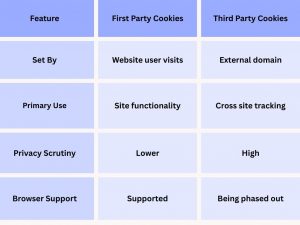
First-Party vs Third-Party Cookies
Understanding the distinction between first-party and third-party cookies is critical for publishers navigating today’s privacy-first digital ecosystem. While both fall under the broader category of web cookies, their functionality, compliance risks, and revenue implications differ significantly.
- First-Party Cookies
First-party cookies are set directly by the website a user is visiting. Because they originate from the same domain displayed in the browser’s address bar, they are primarily used to support core website functionality and improve user experience.
For publishers, first-party cookies are essential for:
- Login sessions – Keeping users authenticated as they navigate across pages
- Analytics – Tracking on-site behaviour, engagement, and performance metrics
- Preferences – Remembering language settings, dark mode selections, or content choices
These cookies are generally considered more privacy-friendly because the data collected stays within the publisher’s domain. Browsers such as Safari and Firefox continue to support first-party cookies, making them central to future-proof monetization strategies.
As third-party tracking declines, publishers are increasingly investing in strong first-party data strategies to maintain targeting and measurement capabilities.
- Third-Party Cookies
Third-party cookies are set by a domain different from the one a user is actively visiting. These cookies are typically deployed through ad tags, embedded scripts, or external platforms integrated into a publisher’s site.
They are commonly used for:
- Cross-site tracking – Monitoring user behaviour across multiple websites
- Advertising – Enabling behavioural targeting and audience profiling
- Retargeting – Showing ads to users based on previous browsing activity
Third-party cookies have historically powered much of the open web advertising ecosystem. However, they have come under intense privacy scrutiny due to their cross-site tracking capabilities.
Browsers like Safari and Firefox already block third-party cookies by default. Meanwhile, Google Chrome is gradually phasing them out, a process often referred to as third-party cookie deprecation. This change aims to limit cross-site tracking and shift toward privacy-preserving alternatives such as browser-based APIs and first-party data solutions.
For publishers, this deprecation represents both a challenge and an opportunity. While traditional behavioural targeting may weaken, investing in contextual advertising and first-party data strategies can help offset revenue risks.
Session Cookies vs Persistent Cookies
Another important distinction within web cookies lies in how long they remain stored on a user’s device. When evaluating the different types of cookies in internet environments, publishers must understand the difference between session cookies and persistent cookies, particularly because storage duration directly affects user tracking, personalization, and compliance requirements.
Session cookies are temporary cookies that exist only during a user’s active browsing session. They are automatically deleted once the browser is closed. These cookies are commonly used for short-term functionality, such as maintaining authentication while a user navigates between pages. For example, when a reader logs into a publisher’s site, a session cookie ensures they stay logged in as they click through articles. Without it, users would need to re-enter credentials repeatedly. Because session cookies do not remain stored long-term, they are generally considered lower risk from a privacy perspective, though they still require transparency in many regulatory environments.
In contrast, persistent cookies remain on a user’s device for a predefined duration, which can range from a few days to several months or even years, depending on configuration. Unlike session cookies, they are not deleted when the browser closes. Persistent cookies are widely used to store user preferences, remember language settings, track repeat visits, and support long-term analytics. They also enable returning user recognition, allowing publishers to identify visitors across multiple sessions and build behavioural insights over time.
The key difference comes down to storage duration. Session cookies are erased immediately after the browsing session ends, while persistent cookies continue to exist until they expire or are manually deleted by the user. For publishers, persistent cookies often play a larger role in monetization strategies because they support audience segmentation and performance measurement over time.
Understanding this duration-based distinction helps publishers balance functionality, personalization, and privacy compliance more effectively.
Secure, HTTP-Only, and SameSite Cookies
Beyond understanding what web cookies and the different types of cookies in internet environments are, publishers must also consider how cookies are configured for security. Certain cookie attributes are specifically designed to protect user data, reduce vulnerabilities, and ensure safer browsing experiences.
Secure cookies are transmitted only over encrypted HTTPS connections. This means the cookie data is sent between the browser and server in an encrypted format, reducing the risk of interception by malicious actors during transmission. For publishers handling login sessions, subscription accounts, or user dashboards, Secure cookies are essential. Without HTTPS encryption, authentication tokens could be exposed through network-based attacks, putting both user data and brand trust at risk.
HTTP-Only cookies add another layer of protection. These cookies cannot be accessed via client-side scripts such as JavaScript. This restriction is critical in defending against cross-site scripting (XSS) attacks, where attackers attempt to inject malicious scripts into a webpage to steal session identifiers. By marking authentication cookies as HTTP-Only, publishers prevent them from being read or manipulated through browser-based scripts, significantly reducing account hijacking risks.
SameSite cookies control how cookies behave in cross-site requests. This attribute determines whether a cookie is sent when a user navigates from one domain to another. SameSite settings help mitigate cross-site request forgery (CSRF) attacks, where unauthorized commands are transmitted from a user’s authenticated session. Modern browsers increasingly enforce SameSite policies by default, limiting how cookies function across domains, especially in third-party contexts.
For publishers, these security-focused cookie configurations are not optional best practices; they are essential components of responsible data handling. Secure implementation protects user trust, supports regulatory compliance, and reduces exposure to legal and reputational risks.
In a privacy-first digital environment, properly configured cookies are just as important as understanding their purpose.
The Role of Cookies in Digital Advertising
In digital advertising, web cookies have played an essential role for almost two decades. Using cookies, advertisers and publishers can produce effective ads and track metrics such as conversions and performance metrics.
One of the main uses of cookies in advertising is for behavioural targeting. Using behaviours tracked via cookies, advertisers create audience profiles from user behaviours such as interests, content consumption, and engagement patterns, which enable the delivery of ads relevant to a user/group. This improves the click-through rate (CTR) and conversion rate.
Another common use of cookies is for retargeting. Retargeting occurs when an online retailer presents ads to a user after they visited an online product page and left without converting (this can occur on multiple websites). Historically, this approach has produced a strong return on ad spend (ROAS) because advertisers are focusing on users that have indicated interest.
Cookies further assist with conversion tracking. Cookies assist with tracking a user’s completion of an action such as signing up for a newsletter or purchasing after clicking on or seeing an ad. Conversion tracking is imperative to the successful measurement of campaign performance.
Additionally, cookies aid in attribution, which is used for understanding the effects on users of different touchpoints prior to converting (first-click, last-click, or multi-touch attribution). Cookies provide the needed identifiers for tracing the user journey across different sessions and devices.
Real-time bidding (RTB) has traditionally been made possible through the use of cookies in programmatic advertising. When a publisher has an open ad impression, the demand-side platform uses cookie-based data to determine the value of a buyer’s audience for bidding in real time (usually under 100ms), providing greater efficiency and revenue-generating potential for publishers than outside of a programmatic model.
However, due to the sunset of third-party cookies (especially in browsers like Google Chrome), many changes are underway. The ecosystem is transitioning to privacy-first solutions including contextual targeting, which allows for placing advertising based on the content a user is viewing as opposed to the user’s behaviour. Contextual solutions use keywords, themes, and semantic signals to deliver creative without requiring persistent user tracking.
For publishers operating in a post-cookie environment, first-party data and contextually relevant monetization solutions will require an increase in focus and commitment.
The Decline of Third-Party Cookies
The digital advertising ecosystem is undergoing one of its biggest structural shifts: the gradual decline of third-party cookies. Once central to cross-site tracking and behavioural advertising, these cookies are now being restricted or eliminated by major browsers, fundamentally changing how publishers approach monetization and data strategy.
- Browser Changes
Browser manufacturers are taking steps to reduce the use of third-party cookies. Safari was one of the first to innovate with the introduction of the Intelligent Tracking Prevention (ITP) feature, which severely restricts how users can be tracked across different sites. Firefox has taken similar measures, blocking access to third-party tracking cookies directly with Enhanced Tracking Protection (ETP).
However, Google’s Chrome browser, with the highest global market share of all browsers, will be making the most dramatic change. Chrome has started the process of phasing out the use of third-party cookies in favour of a new set of privacy-centric alternatives through its Privacy Sandbox project. Although the timeline of the switch has changed several times, the overall direction is clear: the traditional method of tracking users across multiple websites using third party cookies will no longer be possible.
Due to these restrictions implemented at the browser level, even though ad tech providers and publishers may wish to continue using third-party cookies for tracking purposes, they will be unable to do so consistently across all users due to the technical limitations now in place.
- Impact on Publishers
With the decrease in third-party cookies being used it poses issues regarding revenue for Publishers and introduces new operational hurdles. The absence of cookies will result in lower visibility for tracking, which means that advertisers have a diminished ability to build audience profiles and gauge whether their campaign was effective.
As a consequence of the loss of third-party cookies, Publishers have ramped up efforts on First Party Data strategies. Publishers have invested more in user registrations and newsletters, which they use to cultivate a direct relationship with their audience; therefore, First Party cookies will gain additional value because they will still primarily be supported by browsers.
Along with an increase in Server-to-server tracking, and new Identity solutions for privacy compliance, many Publishers will now be able to employ Server to Server data sharing (sending information from their server to the other party’s server) as well as implement other types of privacy-compliant identity solutions that allow them to continue tracking and targeting their customers.
The upcoming change of third-party cookies will create some uncertainty; however, it also creates an opportunity for Publishers to evolve their data strategies and think of new methods to monetise content, and, as a result, be more prepared for success in a digital world where privacy is at the forefront.
Privacy Regulations and Cookie Compliance
As the use of web cookies has expanded, so has regulatory scrutiny. Publishers must now balance monetization goals with strict privacy compliance requirements. Understanding global data protection laws is no longer optional, it’s essential for sustainable digital publishing.
GDPR and Consent Requirements
Publishers across the globe have been impacted by one of the most significant pieces of legislation on privacy ever enacted, the General Data Protection Regulation (GDPR). In addition to the publishers themselves, the GDPR applies to any website that collects or processes data on individuals in the European Union, regardless of the publisher’s country of residence.
Under the GDPR, in addition to prohibiting pre-checked boxes, opt-in consent is required prior to the use of any non-essential cookies, including advertising and tracking cookies. Furthermore, compliance will require that publishers provide users detailed information on the purpose and reason for collecting their data, as well as who will have access to it.
Publishers are required to be fully transparent with users in regard to the categorization of their cookies and provide the user with the ability to actively choose which categorization of cookies they will accept. (For information on how best to meet your GDPR compliance requirements, please refer to Newor Media’s GDPR compliance guide.) Non-compliance can result in heavy fines and significant damage to one’s reputation.
CCPA and Opt-Out Rights
The Consumer Privacy Act (New York), also called CCPA (California Consumer Privacy Act), is equal to, or similar to CCPA; however, it has a different structure for the same general purpose of protecting personal information from third parties using cookies without the explicit consent of the user.
When a publisher wants to market to an audience in California, the publisher must include a very explicit option on their website indicating to users that they have the option to “Not Sell or Share My Personal Information.” Depending on the advertising ID and tracking technology being used by the publisher and any third-party partners, this requirement for the publisher affects how the advertising ID and tracking technology are implemented and tracked.
CMPs, Banner Systems, and Preference Centres
Consent Management Systems (CMPs) have become an essential tool for publishers looking to efficiently manage their compliance obligations. CMPs are used to power cookie banners, to store consent records, and to allow users to manage their preferences via dedicated preference centres.
In conjunction with ad tech vendors, most modern CMPs only allow tracking scripts to fire after the receipt of a valid consent. Additionally, CMPs provide documentation of a user’s choice, which is a critical component of the accountability principle of the GDPR.
Why Compliance Matters for Publishers
Privacy compliance is not just a legal formality. It directly impacts business sustainability.
- Avoid fines that can reach millions under major regulations
- Maintain advertiser trust by demonstrating responsible data practices
- Protect brand reputation in an era of heightened privacy awareness
As cookie usage evolves, compliance must be built into the foundation of publisher strategy, not treated as an afterthought.
Cookies Web Security Risks
Cookies have been very useful to websites because they allow websites to remember who the user is and provide a personalized experience to the user. The downside to cookies is that they can create problems for the company whose website has the cookie as well as for the publisher’s brand if they are configured incorrectly.
When configured incorrectly, a typical problem presented by cookies is session hijacking. This occurs when an attacker captures the authentication cookie of a user and uses that cookie to impersonate the user, gaining access to the user’s account. When an attacker obtains a session ID from the hijacked cookie, the attacker will not have to use the user’s password to log into the user’s account. This problem presents a special concern to publishers who have subscription portals, dashboards, or user-generated content.
Another problem associated with cookies is cross-site scripting (XSS). XSS occurs when the attacker injects malicious scripts into a web page and then executes the injected script in the user’s web browser. If an attacker has access to the user’s cookie, the attacker can use JavaScript to retrieve session tokens or other sensitive identifier information. Improperly configured cookies present the potential to provide access to a broader compromise of the user’s account.
Additionally, another common problem associated with cookies is data misuse. If excessive amounts of data are stored for a particular cookie, the potential exists for misuse, thereby exposing the user to unauthorized access. Another situation that presents a threat to publishers is the identification of users using tracking identifiers. This can pose problems for publishers complying with the law because they do not have the ability to openly and effectively govern those identifiers.
To help reduce the threat of vulnerabilities for both users and publishers, publishers are encouraged to implement strong technical protections to their systems.
Publishers should encrypt data when it is transmitted. The use of HTTPS will allow for encryption of the cookie and will help prevent an attacker from intercepting that cookie.
Publishers should configure cookies with the Secure flag. This will ensure that the cookie is only transmitted over an encrypted connection and that the cookie cannot be intercepted or manipulated. Additionally, publishers should use the HTTP-Only attribute to help protect the cookie from being compromised via scripts.
Finally, publishers should use proper expiration settings for their cookies. A reduced expiration time for an authentication cookie will limit the time for an attacker to use the compromised cookie.
Security is not just an IT problem. It is an important responsibility of every publisher to properly configure cookies to protect users, create a strong compliance posture and preserve the trust of users over the long term.
Alternatives to Cookies for Publishers
With third-party tracking declining, it is essential for publishers to expand their focus beyond web cookies if they want to continue monetizing their sites and obtaining insights regarding their audiences. While cookie-based infrastructure will not disappear completely, the industry as a whole is moving quickly towards privacy-friendly alternatives that allow both for the maximization of performance and adherence to privacy requirements.
One of the biggest changes involves the move to first-party data. Rather than relying on third parties to track their users, publishers are creating direct relationships with their audiences through the use of newsletter subscriptions, registration for accounts, purchase of memberships, and gated content.
By collecting first-party data, which has been collected directly from individuals with consent from the individuals providing the information, is more durable in light of the restrictions that browsers are implementing on third-party cookies. The growing number of first-party data sets is increasing the value that advertisers subscribe to publishers `first-party data because it allows them to better understand the behaviours of their customers and to provide more useful information (deterministic signals).
Another alternative that is gaining momentum is contextual targeting. Rather than targeting a user based on their browsing history in the past, contextual targeting analyses the content of a web page in real-time and serves relevant advertisements that match the content of that page.
So, for instance, if there is an article about travel, airlines and hotels may be featured in ads without using any user-level identifiers. Modern contextual systems use the concepts of semantic analysis along with artificial intelligence (AI) in order to provide a higher degree of precision and are a very effective and privacy-friendly way of targeting users.
Tracking also is moving to the server-side. Instead of being fully reliant on browser-based cookies, publishers are now able to shift a number of tracking functions to enable server-to-server integrations. This will reduce the reliance on client-side identifiers for tracking purposes and will increase the level of accuracy of tracking data while at the same time remaining compliant with privacy regulations if they are implemented responsibly.
Also, a number of systems are being created to replace third-party cookie-based tracking with identity systems. These systems use client data (e.g., hashed email) or other consensually obtained identifiers to create privacy compliant user identifiers which can be used across web properties.
Finally, the Privacy Sandbox is a program by Google Chrome that is designed to provide browser-based advertising APIs to support interest-based advertising and measurement without the disclosure of the identity of the individual who was served the advertisement.
Moving forward, publishers must not think about eliminating their data strategies; rather they should be seeking to create diversity in their data strategies. The combination of first-party data, contextual intelligence, and privacy compliant technologies will drive the continued sustainability of the monetization of publishers in a post-cookie-based world.
Common Misconceptions About Web Cookies
Web cookies are a fundamental part of the internet, yet many people do not understand what they actually are. It is therefore critical for publishers to separate fact from fiction when communicating transparently with users about data practices.
A frequent misconception is that cookies are able to take files from the user’s device. Cookies are not able to take files from your computer or mobile device as they cannot access documents or photos that are saved on your device; therefore, cookies are not able take any data from your device other than the information contained within the cookie itself (for example: session ids, or preference settings). Cookies do not have the ability to scan devices or extract user data from a device.
Cookies are not spyware. Some cookies are used for tracking and advertising – however, cookies are not malicious software as cookies do not execute software, nor can cookies install or run on their own. That said however, how cookies are used, particularly in cross -site tracking, has raised privacy concerns and has been subject to regulatory changes and browser restrictions.
Some people think that all cookies track users on multiple websites. This is untrue. For example, a first party cookie will typically operate only on the website that created it and is typically used for I.T. related functions such as maintaining login sessions or remembering user preferences. Ralph based cross site tracking has relied on third party cookies which are being phased out of use on almost all of the major internet browsers.
Finally, there is the belief that deleting cookies will remove all risks to your privacy. While deleting cookies will remove stored identifiers, deleting cookies will not stop you from being tracked in the future and will not stop you from being tracked using other means (for example: fingerprinting or server-side collection of data).
Understanding some of these issues can assist publishers in communicating to their users with integrity and gaining their trust in a privacy-respecting digital ecosystem.
Best Practices for Publishers Using Web Cookies
As privacy standards evolve and third-party tracking declines, publishers must adopt responsible and strategic approaches to managing web cookies. Implementing best practices not only strengthens compliance but also protects revenue and user trust.
- Conduct a Cookie Inventory Audit
Start with a comprehensive audit of all cookies deployed on your website. Identify which cookies are first party versus third-party, their purpose, duration, and associated vendors. Many publishers are surprised to discover legacy scripts or unused tags still firing in the background. An inventory audit ensures you understand exactly how cookies web infrastructure operates across your pages, a foundational step for both optimization and compliance.
- Reduce Unnecessary Third-Party Scripts
Each third-party script added to your site increases privacy risk, page load time, and potential compliance exposure. Evaluate whether every external tracker or advertising script is truly necessary. Removing redundant or low-performing partners not only simplifies consent management but can also improve site speed and user experience.
- Improve Transparency
Clear communication builds user trust. Your cookie policy should explain what cookies on the web are, what types of cookies internet users encounter on your site, and how data is used. Avoid vague language. Instead, categorize cookies (functional, analytics, advertising) and explain their purpose in plain terms.
- Perform Regular Compliance Checks
Privacy regulations continue to evolve. Conduct routine reviews of your consent flows, vendor contracts, and data processing practices to ensure alignment with laws such as the General Data Protection Regulation and the California Consumer Privacy Act. Ongoing monitoring helps prevent costly penalties and reputational damage.
- Implement User-Friendly Consent Interfaces
Consent banners and preference centres should be easy to understand and simple to manage. Offer granular controls, avoid dark patterns, and ensure users can modify preferences at any time. A transparent and user-centric approach improves opt-in rates while reinforcing brand credibility.
By proactively managing cookie practices, publishers can balance monetization, performance, and privacy in a sustainable way.
Future of Cookies in the Publisher Ecosystem
A major factor influencing the future of web cookies is a privacy-first approach to the internet. With global regulations emerging and high restrictions on browsers, web cookie infrastructure will continue to shift from being an open system used for tracking the purchasing of consumers to being a more controlled, transparent way for data to be documented and used with consent by consumers.
For publishers of content, there is an increasing emphasis on first-party relationships; building a direct relationship with one’s audience via subscriptions/registrations/newsletters/memberships will be increasingly important. First-party data (which is collected via consumer consent) will offer increased protection from restrictions placed by browsers and be of greater quality than third-party data, thus allowing advertisers to make better decisions regarding how to spend their money.
Advertisers are also looking for an increase in expectations/literacy. Advertisers expect reliable performance, accuracy regarding how the purchasing behaviours of consumers were attributed to them, and a high degree of accuracy/originality regarding whom they are trying to target. While the use of third-party cookies is dwindling, advertisers are expecting publishers to provide reliable targeting and reporting solution alternatives, i.e., innovations within contextual advertising, identity management systems, and privacy-compliant measurement tools.
Ultimately, cookies will not go away completely. Rather, the intelligent and responsible implementation of cookies will define how successful companies are within this ecosystem; with first-party cookies being critical to the authentication, personalisation, and analytics of websites, while the role of third-party cookies will continue to decline in relation to browser-based APIs, server-side integrations, and contextual-based intel.
Ultimately, how much revenue a company generates in the future will be determined by their ability to combine responsible monetisation practices with the use of first-party data, privacy-compliant technology, contextual targeting and an emphasis on robust consent management practices.
Those companies who understand what cookies are and make the proper adjustments to their respective strategies accordingly, within the confines of this ever-changing ecosystem, will have the best possible opportunity to sustain revenue while providing their users with a high degree of trust in them.
Final Thoughts: What Publishers Must Understand About Web Cookies
Web cookies are central to digital publishing functionality for publishers because they facilitate authentication processes, analytic systems, personalization engines and advertisers’ success in monetizing their content. While many of the same core functions (targeting ads, frequency capping, attribution) would struggle to operate without cookies, it’s important to note that not all cookies serve the same purpose, nor do they comply with the same regulations.
First-party cookies have a different compliance higher level than third-party tracking cookies and understanding the differences in compliance between first-party and third-party cookies is now an issue of strategy rather than technicality.
A critical need for compliance with the General Data Protection Regulation and California Consumer Privacy Act mean publishers must focus on managing data transparently and responsibly while managing their operationally restricted third-party cookies due to a shift toward more restrictive privacy policies across browsers.
The way forward is clear: strong first-party data strategies, which establish meaningful connections between audiences and publishers; investment in contextual advertising; and application of privacy-safe technologies, will define long-term sustainability.
While cookies are still a critical element of digital publishing, their application is changing; therefore, publishers that proactively transition with help from monetization partners like Newor Media will be well-positioned to balance revenue growth with consumer trust in the era of privacy.
Frequently Asked Questions (FAQs)
Q1: What are web cookies?
Web cookies are small data files stored in a user’s browser when they visit a website. These files contain limited information that helps the website remember the user across pages or future visits. Cookies do not run programs or access personal files; they simply store identifiers and preferences that improve website functionality and user experience.
- Stored locally in the browser as text-based data files
- Help websites recognize returning users and maintain sessions
Q2: What are cookies on the web used for?
Cookies on the web are used to support authentication, analytics tracking, advertising delivery, and content personalization. They help users stay logged in, allow publishers to measure engagement, enable ad frequency capping, and deliver relevant content. For publishers, cookies are essential for both operational efficiency and monetization performance.
- Maintain login sessions and remember user preferences
- Power behavioural targeting, retargeting, and campaign measurement
Q3: What are the main types of cookies in internet environments?
The main types of cookies in internet environments include first-party cookies, third-party cookies, session cookies, persistent cookies, secure cookies, and HTTP-only cookies. Each type differs based on who sets it, how long it lasts, and how securely it operates. Understanding these categories helps publishers manage compliance and optimize performance.
- First-party and session cookies support site functionality
- Third-party and persistent cookies are often linked to advertising and tracking
Q4: Are web cookies dangerous?
Web cookies are not inherently dangerous. They cannot execute code or steal files from a device. However, improper configuration or misuse, especially in cross-site tracking contexts, can create privacy or security risks. This is why secure implementation and transparent consent practices are essential for publishers.
- Risks include session hijacking and data misuse if poorly configured
- Security flags and HTTPS significantly reduce vulnerabilities
Q5: Are third-party cookies going away?
Yes, third-party cookies are being phased out by major browsers. Safari and Firefox already block them by default, and Google Chrome is gradually eliminating support. This shift is reshaping digital advertising and encouraging privacy-first alternatives.
- Browser restrictions limit cross-site tracking capabilities
- Publishers are shifting toward first-party data and contextual targeting
Q6: Do publishers need cookie consent banners?
In many jurisdictions, yes. Regulations such as the General Data Protection Regulation require explicit user consent before placing non-essential cookies. Consent banners and preference centres help publishers remain compliant while maintaining transparency about data practices.
- Required under GDPR and similar privacy frameworks
- Must offer clear choices and documented user consent

2 Comments
Comments are closed