Key Takeaways
- Ezoic is an AI-driven ad optimisation platform that uses automated testing and programmatic demand to improve publisher revenue.
- In practice, Ezoic is best suited for high-traffic publishers (often 250K+ monthly users), making it less accessible for smaller or growing sites.
- Revenue with Ezoic can vary significantly due to its reliance on AI testing and traffic quality factors.
- The platform requires technical setup and ongoing involvement, as optimisation is not fully managed.
- Newor Media offers a much lower entry point (starting around 5,000 monthly users) along with fully managed monetisation and more consistent revenue optimisation.
Ezoic is effective for larger publishers with established traffic who have the experience to manage technical components and ongoing adjustments to improve their monetisation performance through AI-based testing models. However, it can take time, experimentation and require a stable, high volume of traffic to produce consistent, incremental revenue increases.
Publishers in earlier stages will find accessibility and non-manual monetisation equally important. This is why Newor Media stands apart; it has a much lower traffic threshold and provides management of optimisation by experienced specialists, making it a more affordable and viable option for publishers seeking to generate revenue without having to remove existing processes that create difficulties in generating the necessary volume of traffic.
What Is Ezoic?
Ezoic is an AI-driven ad optimisation platform that helps website publishers increase advertising revenue through automated ad testing and programmatic demand integration. The platform uses machine learning to experiment with different ad placements, layouts, and densities in order to determine which combinations generate the highest earnings while maintaining user experience.
Publishers who integrate Ezoic gain access to a dashboard where they can monitor traffic analytics, revenue performance, and ad layout experiments. The system connects to Google Ad Exchange and other programmatic demand sources to maximise the value of each ad impression.
While Ezoic is more accessible than many premium ad management platforms, it also comes with certain trade-offs, including potential complexity in setup and varying revenue performance depending on niche and traffic quality.
This review explains how Ezoic works, its minimum traffic requirements, how much it typically pays publishers, and how it compares with alternatives such as Newor Media, which many publishers consider when seeking more advanced programmatic monetisation.
Introduction: Why Publishers Look Beyond AdSense
For many publishers, monetising a website begins with Google AdSense. It’s simple to set up, widely accessible, and requires little technical expertise. However, as websites begin to grow, the limitations of AdSense quickly become clear. Revenue often plateaus, optimisation capabilities are minimal, and publishers have limited control over how ads are displayed or monetised.
At the same time, the digital advertising ecosystem has become far more competitive. Advertisers are prioritising high-quality inventory, and publishers are competing more aggressively for ad spend. This shift has accelerated the adoption of programmatic advertising and revenue optimisation platforms designed to maximise the value of each visitor.
As a result, publishers increasingly explore platforms such as Ezoic, Mediavine, Raptive, and Newor Media. However, one of the biggest deciding factors is no longer just features, it’s accessibility. Many platforms, including Ezoic in practice, tend to favour websites with substantial traffic volumes (often 250K+ monthly users) before delivering meaningful results or approvals.
This creates a gap for small to mid-sized publishers who are growing but not yet at enterprise scale. These publishers still want higher RPMs, better demand, and expert optimisation—but without waiting months or years to qualify.
That’s why platforms like Newor Media are gaining attention, offering monetisation access from as low as 5,000 monthly users, combined with fully managed ad operations. This allows publishers to start optimising revenue much earlier in their growth journey, rather than waiting to meet high traffic thresholds.
Among the platforms commonly considered, Ezoic is often one of the first alternatives publishers research after AdSense, but it may not always be the most accessible or scalable option for every stage of growth.
What publishers ultimately want is straightforward: higher RPMs, stronger advertiser demand, and less time spent manually optimising ad layouts. They also want solutions that can balance revenue growth with user experience, ensuring that increased monetisation does not negatively impact engagement or site performance.
Among the platforms available today, Ezoic is often one of the first alternatives publishers explore after AdSense.
Understanding Ezoic
Ezoic is an AI-driven ad optimisation platform designed to help publishers increase their advertising revenue through automated testing and programmatic advertising. Instead of relying on static ad placements, Ezoic uses machine learning to dynamically test different ad positions, layouts, and densities to determine what generates the highest earnings while maintaining user experience. This makes it particularly appealing for publishers who want to move beyond the limitations of traditional ad networks like AdSense.
At its core, Ezoic acts as a programmatic advertising intermediary. It integrates with Google Ad Exchange and other demand sources to run real-time auctions for ad inventory. The platform also provides analytics tools that allow publishers to monitor performance, track RPM changes, and evaluate how different layouts impact user behaviour. However, while Ezoic offers automation, it is not a fully managed ad partner. Publishers are still responsible for many aspects of setup, configuration, and ongoing optimisation decisions.
Key components of Ezoic’s technology stack include:
- Machine learning-based ad optimisation
- Google Ad Exchange integration
- Automated layout and ad placement testing
- Traffic and engagement analytics
Important limitations to understand:
- Not a fully managed monetisation solution
- Requires ongoing configuration and oversight
- Publishers retain responsibility for infrastructure and optimisation decisions
Some publishers prefer fully managed monetisation partners such as Newor Media, where the ad operations team handles optimisation, infrastructure, and programmatic demand.
How Ezoic Works for Publishers
Step 1: Integration
To get started with Ezoic, publishers must first integrate their website with the platform. This can be done through DNS integration, a WordPress plugin, or by connecting via Cloudflare. DNS integration is the most common method, but it can be technically complex, especially for those unfamiliar with domain configurations. Once connected, Ezoic gains the ability to control how ads are served across the website.
Step 2: AI Ad Testing
After integration, Ezoic begins testing different ad placements and layouts using its AI system. It experiments with variables such as ad positions, sizes, and density to determine which combinations generate the best results. This process runs continuously and is designed to optimise revenue over time, although results can vary depending on traffic and niche.
Step 3: Programmatic Auctions
Ezoic monetises traffic by connecting to programmatic demand sources, including Google Ad Exchange. Advertisers compete in real-time auctions to display their ads on your site. This auction-based system can increase competition for your inventory, potentially leading to higher CPMs compared to basic ad networks.
Step 4: Continuous Optimisation
Once the system is running, Ezoic continuously adjusts ad layouts based on performance data. It attempts to balance revenue generation with page speed and user experience. However, achieving this balance often requires ongoing monitoring and adjustments by the publisher.
Ezoic Minimum Traffic Requirement
One of the key reasons many publishers consider Ezoic is its relatively accessible entry requirements compared to premium ad networks. Historically, Ezoic required publishers to have at least 250,000 monthly visits before they could join the platform. This made it a stepping stone between beginner ad networks like AdSense and premium networks with stricter thresholds.
In recent years, however, Ezoic has introduced programs such as Ezoic Access Now, which allow smaller publishers to apply even if they do not meet the traditional traffic requirements. This has made the platform more inclusive and appealing to newer websites that are still in the early stages of growth.
That said, traffic volume is only one part of the equation. Traffic quality plays a significant role in determining eligibility and revenue potential. Ezoic evaluates factors such as content originality, compliance with advertising policies, user engagement metrics, and whether the website operates in an advertiser-friendly niche. Websites with low-quality or non-compliant content may still struggle to get approved or perform well on the platform.
Compared to premium networks like Mediavine or Raptive, Ezoic is generally easier to join. However, accessibility does not always guarantee optimal results. Publishers should also consider the technical and strategic requirements involved in maximising revenue.
Ezoic Revenue Potential: How Much Does Ezoic Pay?
Understanding how much Ezoic pays is one of the most common questions publishers have. The short answer is that earnings can vary significantly depending on several factors. Unlike fixed-rate ad networks, Ezoic operates within a programmatic ecosystem where revenue is influenced by demand, competition, and user behaviour.
Traffic Geography
The location of your audience plays a major role in determining earnings. Traffic from countries like the United States, Canada, and the United Kingdom typically generates higher CPMs due to stronger advertiser demand.
Niche Category
Certain niches, such as finance, technology, and health, tend to attract higher-paying advertisers. Websites in these categories often see better RPMs compared to general content or low-value niches.
Audience Engagement
Metrics such as session duration, pages per visit, and bounce rate influence how valuable your traffic is to advertisers. Higher engagement generally leads to better monetisation outcomes.
Seasonal Ad Demand
Advertising budgets fluctuate throughout the year. For example, Q4 often sees higher CPMs due to increased spending during the holiday season, while other periods may experience lower demand.
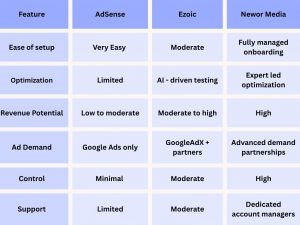
While Ezoic can improve revenue compared to AdSense, results are not always consistent. Some publishers report fluctuations due to the platform’s reliance on automated testing. In contrast, fully managed programmatic partners such as Newor Media may offer more stable RPM optimisation depending on the website’s traffic profile.
Ezoic vs AdSense vs Managed Ad Platforms
Ezoic Dashboard: Features and Reporting
Ezoic provides publishers with a powerful dashboard to give them an overview of their current ads’ performance. Publishers can view how much they are making daily from ads, track RPM trends and how layout changes can affect revenue as well as traffic analytics that allow publishers to see where users are coming from and how they’re engaging with the site.
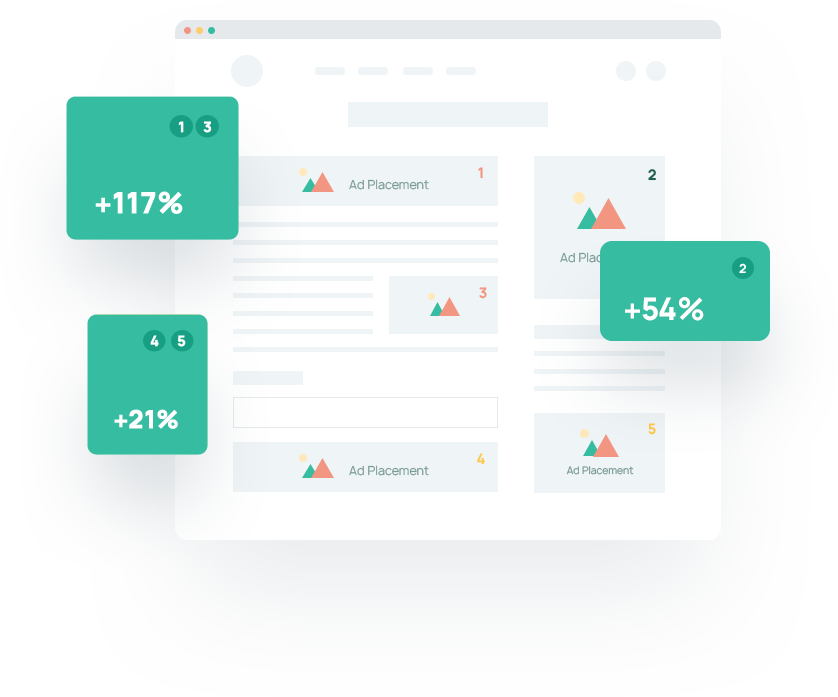
A unique element of this dashboard is a Report on Layout Testing that allows any publisher to see how different configurations of their ads perform over a period of time. This will provide publishers the opportunity to evaluate which configurations are creating the most income as well as those that are adversely impacting the user experience. Despite having all of the data available regarding ad performance, the majority of the ad optimisation process is highly dependent upon the platform’s artificial intelligence system.
The Dashboard provides an overall perspective as to how ads are performing, however, experimentation will continue to be necessary for advertisers. Many publishers continue to employ the process of trial-and-error to optimise their monetisation strategy, as there is no expert assistance available to support this process. This can be time-consuming for those without knowledge of the industry.
Ezoic Competitors and Alternatives
Mediavine is one of the most well-known premium ad networks in the publishing space. It is particularly popular among lifestyle and blogging websites. However, it requires a high level of monthly traffic, making it less accessible for smaller publishers. Those who qualify often benefit from strong RPMs and managed ad services.
Raptive (formerly AdThrive) is another premium network focused on high-quality publishers. It has strict eligibility requirements and prioritises sites with significant traffic and strong engagement metrics. In return, publishers gain access to premium advertisers and managed optimisation.
Monumetric sits between entry-level and premium ad networks. It has moderate traffic requirements and offers a more hands-on approach compared to fully managed platforms. While it provides better revenue potential than AdSense, it may still require some level of optimisation from the publisher.
Newor Media is positioned as a strong alternative for publishers looking for a balance between accessibility and performance. It offers flexible onboarding, making it suitable for a wide range of publishers. The platform provides advanced programmatic infrastructure, including header bidding, along with a dedicated optimisation team that manages ad performance.
Key benefits include transparent reporting, customised monetisation strategies, and access to high-quality demand partners. For publishers who prefer a hands-off approach, Newor Media can be a compelling alternative to platforms like Ezoic.
Advantages of Using Ezoic
- AI-driven layout testing for continuous optimisation
- Access to Google Ad Exchange demand
- Lower traffic entry barrier compared to premium networks
- Ability to test multiple ad placements automatically
- Detailed analytics and reporting dashboard
- Potential to increase revenue beyond AdSense
- Flexible integration options (DNS, plugin, Cloudflare)
- Suitable for growing publishers transitioning from basic ad networks
Limitations and Challenges of Ezoic
Ezoic has sophisticated features to help publishers optimise their websites, but when compared to fully managed services, there are limitations to consider.
One of the biggest impediments to Ezoic is accessibility at scale. Although Ezoic claims to be accessible, many publishers have not been able to achieve meaningful results or acceptance due to needing at least 250,000 unique monthly visits before they can do so, making it difficult for smaller and medium-sized publishers to receive optimal benefits from Ezoic in its early stages.
Another challenge with Ezoic is the technical complexities associated with setting it up. Publishers with little or no technical experience may have a difficult time setting up Domain Name System (DNS) integration as well as implementing Ezoic correctly, which will likely lead to downtime, software performance issues, and/or interruptions in ad delivery for the publisher. All of these aforementioned items would adversely affect their revenue and user experience.
One more challenge that Ezoic presents is that loading speeds may be negatively affected due to its use of aggressive ad testing and many variations of page layouts in order to help users find content easier, but if these changes are not implemented correctly, the page load speeds could be slower than expected. Slower page loading times will have a negative effect on SEO ranking, user engagement indicators and user satisfaction.
A major downside of Ezoic is the inconsistent monthly payouts. Since Ezoic is based on artificial intelligence (AI) for experimentation purposes, publishers received variable payouts while Ezoic is still performing tests on versions of the same page layout. While the result of the experimentation should eventually increase performance, many publishers do not possess the tools needed to manage this level of volatility in the long run.
Ezoic also provides less strategic assistance compared to many of the fully managed service providers. In most cases, the publisher is responsible for tracking their performance and making decisions on how they would like to optimise their revenue as well as their users’ experience.
As discussed, Ezoic has many challenges that will become significant barriers for many publishers, especially for those that have lower thresholds for traffic. These barriers emphasise the value of transitioning to Newor Media where onboarding is simple, optimisation is achieved through complete management and growing your revenues does not rely on obtaining hundreds of thousands of unique visits per month.
When Newor Media May Be a Better Alternative
Newor Media offers an easier and better way for publishers to monetise without having the burden of highly technical complexities or large traffic barriers; making it a much more viable & scalable option than Ezoic for many publishers. The biggest benefit of going with Newor Media is the lower entry level for publishers. While Ezoic requires typically a higher level of traffic to become viable (around 250K+ users/month), Newor Media allows publishers to start monetising at only 5,000 users/month. This allows publishers with growing websites to optimise their revenue much sooner than they would using traditional methods by having to wait to achieve large amount of traffic.
In addition to being accessible, Newor Media also provides a fully managed monetisation solution. Unlike Ezoic, publishers do not rely only on AI impacts in determining how to monetise their website. Publishers also have access to a dedicated ad operations team that takes care of all aspects of ad operations including set-up, management and optimisation, as well as demand management. As a result, publishers do not need to go through trial-and-error as they develop their revenue streams.
This advanced infrastructure along with human resources can also lead to increasing the levels of RPM that a publisher can receive by offering more consistent results from their ad units/placements. The infrastructures and human resources include features like header bidding and partnerships with premium demand, as well as tailored monetisation and will ensure that the ad units/placements on each website are created specifically for that publisher’s characteristics such as its audience and traffic profile.
Newor Media is particularly well-suited for:
- Publishers with growing traffic who want to monetise earlier
- Websites seeking higher and more stable RPMs
- Publishers who prefer a hands-off, fully managed solution
- Sites that need customised monetisation strategies rather than generic optimisation
With dedicated account managers, transparent reporting, and a focus on long-term revenue growth, Newor Media provides a more practical path for publishers who want to scale without waiting to meet the high entry barriers associated with platforms like Ezoic.
Is Ezoic Worth It for Publishers?
- Suitable for mid-size publishers looking to move beyond AdSense
- Good option for websites experimenting with AI-driven optimisation
- Accessible entry point compared to premium ad networks
- Useful for testing ad layouts and understanding monetisation potential
- Can increase revenue compared to basic ad platforms
However:
- May not provide consistent revenue for all publishers
- Requires technical setup and ongoing management
- Limited strategic support compared to managed platforms
- Not ideal for publishers seeking fully hands-off monetisation
- Alternatives may offer stronger long-term optimisation
Final Thoughts: Ezoic in Today’s Publisher Landscape
Ezoic is still the preferred monetization platform for emerging publishers largely due to its ease of use and artificial intelligence incorporated into optimizations. Ezoic serves as a connection point between basic advertisement networks such as Adsense and fully serviced premium monetization solutions. Publishers willing to perform the investment in time setting up Ezoic will see large increases in advertising revenue.
In the last few years, the digital advertising landscape has changed significantly. Publishers now have much higher expectations of a monetization solution. Not only do they expect revenue to be optimized but also that they receive strategic advice, the best infrastructure available, and consistent performance. Because of these expectations, many publishers are looking to managed partners who specialize in the complexities of the modern digital advertising landscape.
As more and more publishers seek higher revenue potential and a more efficient monetization method, platforms such as Newor Media are gaining in popularity along with traditional ad networks. In the end, the best solution for your particular web site will be determined based on your web site’s traffic levels, demographic make-up of your audience, and long-term development strategy.
FAQ Section
What is Ezoic?
Ezoic is an AI-driven ad optimisation platform that helps publishers improve their ad revenue by testing different ad layouts and connecting websites to programmatic advertising demand. It uses machine learning to determine which ad placements generate the highest earnings while maintaining user experience.
- Uses automated layout testing
- Integrates with Google Ad Exchange
What is the Ezoic minimum traffic requirement in 2026?
Historically, Ezoic required around 10,000 monthly visits, but newer programs now allow smaller publishers to apply. Approval depends not only on traffic volume but also on content quality, compliance, and engagement metrics.
- Lower barrier to entry than premium networks
- Traffic quality still matters significantly
How much does Ezoic pay publishers?
Ezoic earnings vary widely depending on factors such as traffic location, niche, and audience engagement. RPMs can differ significantly between websites, making it difficult to estimate a fixed income.
- Higher CPMs for US traffic
- Seasonal demand impacts revenue
What are Ezoic competitors?
Common Ezoic competitors include Mediavine, Raptive, Monumetric, and Newor Media. Each platform offers different levels of access, optimisation, and support depending on publisher size and needs.
- Premium networks require higher traffic
- Managed platforms offer more support
Is Ezoic better than AdSense?
Ezoic generally provides more advanced optimisation tools and access to programmatic demand compared to AdSense. However, some publishers prefer fully managed platforms like Newor Media for better long-term revenue optimisation and support.
- More control and testing than AdSense
- Managed platforms may offer higher consistency
2 Comments
Comments are closed