Key Takeaways: First Party Data Strategy for Publishers
- First party data is becoming the most valuable asset for publishers in a cookieless world
- Publishers who own audience data gain better monetisation, targeting, and control
- AI models and ad platforms increasingly rely on publisher-owned data signals
- A strong first party data strategy improves RPM, user engagement, and retention
- Data collection must be privacy-first and consent-driven
- First party data enables direct advertiser relationships and premium pricing
- Platforms like Newor Media help publishers activate and monetise first party data more effectively
What Is a First Party Data Strategy?
A first party data strategy is a structured approach used by publishers to collect, manage, and utilise data directly gathered from their audience. This includes data such as website behaviour, user preferences, email subscriptions, and engagement patterns.
Unlike third-party data, which relies on external tracking (like cookies), first party data is owned and controlled by the publisher. This makes it more reliable, privacy-compliant, and valuable for advertisers.
In 2026, first party data has become a critical component of publisher growth as the industry shifts toward privacy-first advertising and AI-driven targeting. Publishers who effectively leverage their own audience data can improve ad performance, increase revenue, and build stronger relationships with advertisers.
This guide explains what first party data is, how to build a first party data strategy, and how publishers can use it to future-proof their monetisation.
Introduction: Why First Party Data Is the Future of Publishing
The publishing industry is undergoing one of the biggest structural changes in digital advertising history. For years, publishers relied heavily on third-party cookies, external tracking tools, and platform-level audience insights to drive monetisation. That model is rapidly disappearing.
The death of third-party cookies has fundamentally changed how advertisers reach audiences online. Major browsers have reduced support for third-party tracking, while privacy-first technologies continue to limit cross-site user identification. At the same time, global regulations such as GDPR, CCPA, and other evolving privacy frameworks are making external tracking more difficult and more restricted than ever before.
This means publishers can no longer depend solely on external data ecosystems to understand their users.
The key shift happening across the industry is clear:
Traffic-focused → Audience ownership-focused
Previously, success was often measured by pageviews, impressions, and raw traffic volume. While traffic still matters, publishers today are increasingly prioritising owned audience relationships. This means collecting meaningful user data directly from site interactions, subscriptions, signups, and engagement behaviour.
In 2026, audience ownership is no longer just a strategic advantage-it is a core business asset.
Another major factor accelerating this shift is the rise of AI-driven advertising and content systems. AI-powered ad platforms, recommendation engines, and programmatic demand tools are increasingly trained and optimised using publisher-owned audience signals. The richer your owned data ecosystem, the stronger your targeting, optimisation, and revenue potential becomes.
This makes first party data a major competitive differentiator.
Publishers who understand their audience deeply can command better advertiser relationships, create stronger personalised experiences, and generate more sustainable long-term revenue.
To build an effective strategy, the first step is understanding exactly what first party data actually is.
What Is First Party Data?
If you are asking what is first party data, the simplest definition is:
- First party data is information collected directly from your audience through your own digital properties and interactions.
- It comes from users who engage with your website, app, newsletter, membership platform, or other owned channels.
- Unlike third-party data, it does not rely on external tracking vendors or cross-site cookie networks.
Common examples of first party data
- Page views and session activity
- Email signups and newsletter subscriptions
- Purchase behaviour and transaction history
- On-site engagement signals such as clicks, scroll depth, and dwell time
- Content preferences based on categories consumed
- Account registration data from logged-in users
First party vs third party vs zero party data
- First party data: collected directly from users through your own platform
- Third party data: purchased or sourced from external providers
- Zero party data: intentionally shared by users, such as survey responses or stated preferences
Why first party data is the most valuable
- Highest accuracy because it comes directly from real interactions
- Highest trust due to transparent collection methods
- Better compliance with privacy regulations
- Long-term ownership without reliance on external platforms
In simple terms, first party data offers the strongest combination of accuracy, trust, and control, making it the most valuable data asset for publishers.
Types of First Party Data for Publishers
Publishers can collect multiple categories of first party data, each serving a different strategic purpose.
Behavioural data
- Page views
- Scroll depth
- Click paths
- Session frequency
- Return visits
- Exit pages
This helps publishers understand how users behave on-site.
Demographic data
- User age brackets
- Location
- Device type
- Language
- Account information
This helps create audience profiles for monetisation and segmentation.
Contextual data
- Articles consumed
- Topic preferences
- Category affinity
- Reading patterns
- Content format preference
This helps identify what users are interested in.
Engagement data
- Time on site
- Time per article
- Newsletter opens
- CTA clicks
- Video completion rates
These signals help measure content quality and monetisation potential.
Logged-in user data
- Subscription status
- Membership tier
- Historical engagement
- Premium content usage
This is often the highest-value first party data layer because it is deterministic and highly accurate.
The deeper and richer your data stack becomes, the greater the monetisation opportunities available.
Why First Party Data Strategy Matters
A strong first party data strategy is now central to publisher success.
Key benefits
- Better ad targeting
- advertisers can reach relevant audiences with higher precision
- Higher CPMs
- audience intelligence enables premium inventory pricing
- Improved retention
- personalised content experiences keep users engaged longer
- Direct advertiser deals
- publishers can offer audience-based inventory packages
- Reduced platform dependency
- less reliance on external ad ecosystems
Industry-wide shift
Advertisers increasingly prefer deterministic data over probabilistic tracking.
This means known audience signals-such as logged-in behaviour, newsletter engagement, or content interests-are far more valuable than anonymous cookie assumptions.
Publishers with mature data strategies are consistently outperforming those relying only on raw traffic.
Traffic brings reach.
Data brings revenue.
How to Build a First Party Data Strategy
This is the most important section of the entire framework.
A successful first party data strategy is not just about collecting data. It is about building a system that converts audience signals into monetisation, retention, and long-term growth.
Data Collection (Foundation Layer)
- Forms
- account creation
- newsletter signup
- gated content
- lead capture forms
- Email capture
- newsletter opt-ins
- content upgrades
- membership forms
- On-site tracking
- session analytics
- clicks
- scroll depth
- referral sources
- Surveys
- preference polls
- content interests
- advertiser intent data
The goal is to collect high-intent signals while maintaining transparency.
Data Infrastructure
A data strategy is only as strong as its infrastructure.
- Analytics tools
- Google Analytics
- event tracking
- engagement dashboards
- CDPs
- customer data platforms unify user signals across channels
- Data storage
- secure warehousing
- cloud-based segmentation systems
Without centralised infrastructure, data remains fragmented and difficult to activate.
Audience Segmentation
Segmentation converts raw data into usable business intelligence.
- Behaviour-based segments
- repeat readers
- high-session users
- category loyalists
- Interest-based segments
- finance readers
- gaming users
- academic audience
- High-value users
- newsletter subscribers
- logged-in members
- premium readers
This layer is essential for advertiser monetisation.
Data Activation (Monetisation Layer)
This is where data becomes revenue.
- Programmatic ads
- audience-targeted demand packages
- Direct deals
- premium advertisers pay more for known segments
- Audience targeting
- custom PMP and private marketplace setups
This is often where publishers underperform.
Collection is common.
Activation is the real differentiator.
Personalisation
- Content recommendations
- increase session depth
- UX improvements
- personalised homepage feeds
- relevant article suggestions
Personalisation directly improves retention and lifetime value.
AI & Machine Learning Integration
AI systems increasingly depend on publisher-owned signals.
This includes:
- predictive churn models
- advertiser audience matching
- content recommendation engines
- yield optimisation systems
In 2026, first party data is becoming a foundational layer for machine learning systems.
Continuous Optimisation
No data strategy is static.
Continuous optimisation should include:
- A/B testing
- segment refinement
- CPM analysis
- retention tracking
- revenue per user analysis
The strongest publishers treat first party data as an evolving revenue engine.
First Party Data Marketing for Publishers
First party data marketing refers to using owned audience signals to improve communication, engagement, and monetisation.
In order to create highly tailored email campaigns, market back to the audience (for retargeting), facilitate subscription growth, and develop custom advertising experiences, publishers can utilize this information. As opposed to sending generic campaigns, all publishers now have the ability to segment their users by interest, engagement history and behavioural habits.
For example, a finance publisher could send an entirely different newsletter to users who regularly access investing articles; whereas the same publisher would develop a different newsletter for an individual that read predominantly personal budgeting articles.
By taking this user segmentation strategy and implementing it into the advertiser’s promotion vehicle, the individual advertiser is then able to serve an exceptionally relevant advertisement based upon both contextual and behavioural triggers.
The outcome is clear:
higher engagement + higher revenue
This is one of the strongest use cases for first party data marketing.
How First Party Data Increases Ad Revenue
First party data directly improves monetisation.
When advertisers know exactly who they are targeting, they are willing to pay significantly higher CPMs.
This improves:
- campaign performance
- conversion rates
- viewability alignment
- audience quality
As a result, publishers often see:
- higher CPMs
- better fill rates
- premium advertiser demand
- stronger direct deals
Platforms such as Newor Media help publishers activate these audience insights through advanced programmatic infrastructure, header bidding, and demand partnerships.
The result is more efficient yield optimisation and stronger revenue performance.
Common Challenges in First Party Data Strategy
Despite its importance, many publishers struggle with execution.
Common challenges include:
- limited collection mechanisms
- fragmented tools
- privacy compliance requirements
- technical implementation issues
- weak activation workflows
In practice, most publishers do not struggle with collection.
They struggle with activation.
Turning raw signals into revenue is the biggest challenge.
First Party Data vs Third Party Data
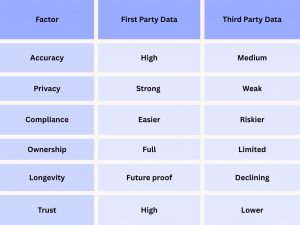
The key takeaway is simple:
first party data is future-proof
When to Use a Managed Monetisation Partner
A managed monetisation partner is best for:
- publishers with growing traffic
- sites lacking technical expertise
- publishers wanting stronger data monetisation
The biggest advantage is the ability to convert audience data into revenue through:
- header bidding
- audience targeting
- demand optimisation
- yield management
This is especially valuable for publishers scaling fast.
Best Tools for First Party Data Strategy
- Google Analytics
- behavioural tracking
- event measurement
- CDPs
- audience unification
- cross-channel segmentation
- CRM tools
- lifecycle communication
- advertiser relationship management
- email automation tools
- segmentation-driven engagement
Final Verdict: Is First Party Data Strategy Essential?
Yes – it is absolutely essential.
It is no longer optional for publishers.
Without a strong first party data strategy, growth becomes increasingly limited in a cookieless world.
Key takeaways
- without it → limited scale
- without it → weaker CPMs
- with it → stronger audience ownership
- with it → scalable revenue
- with it → premium advertiser demand
Publishers who invest early gain a significant competitive advantage.
Conclusion: The Future of Publisher Monetisation
The future without cookies is upon us. The strength of publishers is now measured by their data ownership. The publishers that will be the largest in 2026 will have successfully combined first-party audience intelligence, Artificial Intelligence (AI) optimisation and the ability to monetise via programmatic methods. Audience ownership has moved from being purely a support function to a strategic means of generating revenue. Publishers that can combine their first-party data strategy and monetisation will take centre stage in the next chapter of digital advertising. Professional ad management platforms are the ones who help publishers.
FAQ Section
What is a first party data strategy?
A first party data strategy is a structured framework for collecting, storing, segmenting, and activating audience data gathered directly from your own users. It helps publishers improve targeting, monetisation, retention, and compliance in a privacy-first environment.
- focuses on owned audience signals
- converts data into revenue
What is first party data?
First party data is information collected directly from users through website visits, subscriptions, signups, engagement events, and purchases.
- highest trust
- highest accuracy
Why is first party data important?
It improves targeting, strengthens compliance, and increases revenue opportunities.
- better CPMs
- stronger retention
How do publishers use first party data?
Publishers use it for ad targeting, content personalisation, audience segmentation, and direct advertiser deals.
- monetisation
- personalisation
What is first party data marketing?
It refers to using owned audience data to create personalised campaigns and improve engagement.
- targeted email campaigns
- custom ad experiences
One Comment
Comments are closed