What Is Audience Targeting?
The process of identifying and segmenting audiences to target specific groups with relevant content or ads based on their behaviour, interest, demographics or intent. Publishers can create relevant experiences for users and deliver higher value impressions for advertisers through audience targeting by understanding their visitors (users) by using audience data to see who they are, what they care about, as well as when they will most likely engage with or convert to advertisers’ products or services; this data is acted upon through audience targeting platforms and ad tech systems. As of 2026, the landscape of audience targeting has shifted away from cookie-based audience targeting and to advanced usage of first-party data, contextual signals and Artificial Intelligence (AI) driven audience targeting models to provide greater levels of relevance while maintaining user privacy. This guide will provide an introduction to audience targeting, how it works, the different types of audience targeting, and how publishers can leverage it as a revenue driver for sustainable growth.
Introduction: The Evolution of Audience Targeting
Audience targeting has changed significantly over the past few years as digital media advertising has evolved. The earliest digital publishers depended on broad-based targeting to deliver the same ads to every visitor regardless of their individual characteristics or interests. In the early days of digital advertising, advertisers were to a large degree, measuring their successes based only on reach and impressions. In addition to a lack of understanding of who the audience was actually behind the traffic that had been generated when measuring success; this approach was very effective in generating mass scale results, however did not produce relevant advertising results nor were they engaged with in any significant way; therefore these campaigns generated minimal or no value for advertisers.
The second large change in the marketplace occurred through the use of cookie based precision targeting. As third-party cookie technology and cross-site cookie technology became more prevalent; both advertisers and publishers have been able to create profiles on their users; this has allowed them to track the actions taken on the website along with other actions across the internet and then serve more personalized advertisements. For a large part of the last few to several years; the creation of personalized audiences has defined how advertisers would engage with their audiences. Essentially by segmenting their audience based on interests, demographics and browser history; publishers were able to create and generate more targeted ad campaigns, while at the same time providing the publishers access to higher CPMs. The downside of the previous methods is that third-party data has created a very fragile ecosystem, which relies heavily upon very opaque data practices and third-party cloud-based platforms and their associated cost.
As of today, the industry is undergoing yet another transformative change. New laws, such as GDPR and the ever-evolving privacy framework have changed how publisher’s target their audiences in regard to advertising. Privacy regulations, browser restrictions, and increasing consumer awareness have changed how to effectively target your audience, making the transition from third-party cookies to focusing on privacy first (first-party data, contextual information, and compliant technologies).
By 2026, the importance of targeting for advertisers would be of paramount importance; therefore, audience targeting will become an integral part of the business strategy for all publishers. In order to locate and target these audiences, advertisers want high-quality addressable audiences, while consumers are demanding more control, transparency, and choice in terms of their privacy.
The challenge facing publishers is that while they may generate large volumes of useful data about their audiences, very few publishers can actually activate that data in a way that generates significant revenue for them.
If you want to monetise effectively in today’s environment, the only way to do it is to understand your audience, not just the volume of traffic you receive to your site. That’s where Newor Media comes into play – we help publishers to activate their audience data and turn those insights into revenue that can be measured.
What Is Audience Targeting? A Publisher-Focused Definition
Targeting an audience is grouping individuals based on their shared interests, demographics and behaviours, so these people see content and/or advertisements according to how they relate to each other based on some commonality. In terms of what this means for publishers, they need to do more than just have page views and/or sessions (measurements of how many people visit their website, etc.) – both of these measurements can have a very low value without knowing who those readers are, how long they spend engaging with your content and how valuable the reader has been to you, your advertisers and your site overall.
At its fundamental level, targeting an audience will allow publishers to turn anonymous or unknown website traffic into identifiable, higher-value audience segments. These higher-value segments will be comprised of first-party data collected from different sources including, but not limited to; users’ on-site behaviour, consumption of particular types of content, device type (tablet, smartphone, desktop), geographic location, etc. When used in conjunction with each other correctly, these data points enable the ability for a publisher to deliver targeted ads and content without jeopardising their trust and/or privacy with users.
Why Audience Targeting Exists
Audience targeting exists because relevance drives results. For publishers, effective targeting helps:
- Improve ad relevance and yield by matching advertisers with audiences that align with their campaign goals
- Enhance the user experience through ads and content that feel contextual rather than intrusive
- Enable premium monetisation, including higher CPMs and direct-sold audience packages
- Reduce wasted impressions by avoiding broad, low-intent ad delivery
In a competitive and privacy-conscious market, relevance is no longer optional, it’s a revenue requirement.
Audience Targeting for Publishers vs Advertisers
Advertisers and publishers both use targeting methods to reach their audiences, but the reason for using these methods is different for each group. Advertisers usually want to see how their campaigns perform on a large number of different platforms over a relatively short period of time. Publishers, however, use their own data and develop relationships with their audience through repeated uses of first-party audience data. The goal for publishers is to create a monetisation-first strategy that generates sustainable revenue, increases the lifetime value of their audiences, and strengthens their relationships with advertisers. Publisher-led audience targeting does not require the use of any third-party data sources to provide insight into an audience over time, whereas Advertiser-led audience targeting can rely heavily on outside data to create insights and longs-term audience control.
Common Publisher Use Cases
Publishers apply audience targeting across multiple revenue and engagement channels, including:
- Display and video advertising with audience-based deals and PMP packages
- Content personalisation to increase time on site and return visits
- Subscription and membership offer targeted to high-intent users
- Retargeting and advanced segmentation for cross-channel activation
When executed well, audience targeting becomes a strategic asset, one that fuels growth, loyalty, and smarter monetisation.
How Does Audience Targeting Work?
Audience targeting may sound complex, but for publishers, it follows a clear and repeatable process. Understanding this end-to-end flow is essential for turning raw data into measurable revenue and better user experiences.
- A User Visits a Publisher Site
The audience targeting journey begins the moment a user lands on a publisher’s website or app. This interaction creates the opportunity to understand who the user is and how they engage with content, without relying on third-party identifiers.
- Behavioural and Contextual Data Is Collected
As the user navigates the site, first-party data is collected. This includes behavioural signals such as pages viewed, time spent, scroll depth, and engagement frequency, along with contextual data like content category, device type, location, and time of visit. All data collection is governed by consent and privacy frameworks to ensure compliance and transparency.
- Audience Segments Are Created
Collected data is then organised into meaningful audience segments. These segments may represent interests (e.g., finance readers), intent signals (frequent visitors), engagement levels, or lifecycle stages (new vs loyal users). Modern audience targeting platforms and data management tools help publishers automate this segmentation at scale, often using AI to uncover patterns that manual rules would miss.
- Segments Are Activated via Ad Tech
Once defined, audience segments are passed into the publisher’s ad stack. This typically includes ad servers, SSPs, and programmatic platforms where segments can be attached to inventory. At this stage, targeting audience data becomes monetizable, enabling audience-based deals, private marketplaces, and premium direct campaigns.
- Relevant Ads or Content Are Served
Based on the active segment, users are shown ads or content tailored to their interests and intent. Advertisers benefit from higher relevance, while users experience fewer irrelevant ads. Publishers, in turn, see improved engagement, CPMs, and fill rates.
- Performance Is Measured and Optimised
The final step in audience targeting is continuous optimisation. Publishers analyse performance metrics such as revenue, engagement, viewability, and conversion rates. These insights are used to refine segments, improve targeting accuracy, and maximise long-term audience value.
Key Components Involved
A successful audience targeting strategy relies on several interconnected elements:
- First-party data as the foundation
- Audience targeting platforms for segmentation and activation
- Consent and privacy frameworks for compliance
- Ad servers and SSPs for monetisation
- Analytics and reporting tools for optimisation
Together, these components turn audience understanding into sustainable publisher revenue.
Types of Audience Targeting
Publishers can apply multiple types of audience targeting to better understand users and unlock higher-value monetisation opportunities. While each targeting method offers value on its own, the most successful publishers combine several signals to create richer, more actionable audience segments.
Core Audience Targeting Types
Demographic targeting groups users based on attributes such as age range, gender, income level, or education. For publishers, this data often comes from registered users, surveys, or inferred insights. Demographic segments are commonly used for brand campaigns and direct-sold advertising packages.
Behavioural targeting focuses on how users interact with a site. This includes pages viewed, frequency of visits, content consumption patterns, and engagement depth. Publishers use behavioural targeting to identify loyal readers, high-intent users, or visitors likely to convert, making it highly effective for both advertising and subscription offers.
Contextual targeting delivers ads based on the content a user is currently consuming rather than who the user is. For example, an ad about personal finance placed within a finance article. In a privacy-first environment, contextual targeting has regained importance, especially as it requires no personal identifiers and aligns well with regulatory requirements.
Interest-based targeting builds on behavioural and contextual signals to infer broader interests over time. A user who frequently reads technology or sports content can be grouped into interest-based segments, enabling more relevant ad delivery across multiple sessions.
Geographic targeting segments audiences based on location, such as country, region, or city. Publishers often use geographic targeting for local advertising, regional campaigns, or language-specific content, helping advertisers reach audiences in specific markets.
Emerging & Advanced Targeting Methods
As technology evolves, publishers are adopting more advanced audience targeting strategies.
Predictive targeting uses historical data to anticipate future behaviour, such as likelihood to subscribe or engage with premium content. This allows publishers to act proactively rather than reactively.
AI-powered audience targeting leverages machine learning to analyse large volumes of data and automatically create high-performing segments. AI can identify patterns humans might miss, continuously optimise targeting audience strategies, and improve yield over time.
Cohort-based targeting groups users with similar behaviours into anonymised cohorts, balancing performance with privacy. This approach supports scalable targeting without relying on individual identifiers.
First-party data segmentation is the foundation of all advanced targeting strategies. By organising owned data into meaningful segments, publishers maintain control, ensure compliance, and reduce dependence on external platforms.
Publishers that combine multiple targeting types consistently outperform single-signal strategies, delivering better relevance, stronger engagement, and smarter monetisation.
AI Audience Targeting: How It’s Changing Publisher Monetisation
AI audience targeting represents the next evolution of how publishers understand, segment, and monetise their audiences. As manual rules and static segments struggle to keep up with changing user behaviour, artificial intelligence introduces speed, scale, and precision into the targeting process, without compromising privacy-first principles.
What Is AI Audience Targeting?
AI audience targeting uses machine learning models to analyse large volumes of first-party and contextual data, identify patterns, and automatically create high-value audience segments. Instead of relying on predefined rules, AI systems continuously learn from user behaviour to refine targeting in real time.
At its core, AI-driven targeting enables:
- Machine learning–driven segmentation that adapts as user behaviour changes
- Pattern recognition at scale, uncovering correlations across content, engagement, and timing
- Predictive intent modelling, which estimates what users are likely to do next, such as clicking an ad or subscribing
This allows publishers to move from reactive targeting to proactive monetisation.
How Publishers Use AI Targeting
Publishers are increasingly integrating AI into their audience targeting platforms to unlock smarter revenue strategies.
Real-time audience clustering allows users to be grouped dynamically as they browse, rather than being assigned to static segments. This ensures that ads and content remain relevant even as user intent shifts within a session.
Yield optimisation is another major benefit. AI models can analyse historical performance data to determine which audience segments drive the highest CPMs, helping publishers prioritise inventory and pricing strategies that maximise revenue.
Smarter ad placement decisions are also powered by AI. By evaluating user engagement, content context, and ad performance simultaneously, AI helps determine the most effective placements without degrading user experience.
What AI Is Not
Despite its advantages, it’s important to clarify what AI audience targeting is not.
- It is not content spam or excessive personalisation that overwhelms users
- It is not black-box guesswork; modern systems provide transparency and measurable outcomes
- It is not a replacement for strategy, but a tool that enhances data-driven decision-making
When used responsibly, AI audience targeting empowers publishers to activate their data more effectively, respect user privacy, and build sustainable monetisation models in an increasingly competitive digital ecosystem.
Audience Targeting Platforms Explained
An audience targeting platform is a technology solution that helps publishers collect, organise, segment, and activate audience data across multiple monetisation channels. These platforms act as the bridge between raw first-party data and revenue, enabling publishers to turn audience insights into targeted advertising, personalised content, and higher yield.
For publishers operating in a privacy-first, cookie less environment, the right platform is no longer optional, it’s foundational.
Key Capabilities to Look For
When evaluating an audience targeting platform, publishers should prioritise the following capabilities:
- First-party data management
Centralised collection and unification of behavioural, contextual, and declared user data to create actionable audience segments. - Privacy and consent compliance
Built-in support for consent frameworks, data governance, and regional privacy regulations to ensure compliant audience activation. - Integration with the ad stack
Seamless connectivity with ad servers, SSPs, and programmatic platforms to activate targeting audience segments without workflow friction. - Real-time optimisation
The ability to update audience segments dynamically based on live user behaviour and performance signals, rather than static rules. - Audience insights and reporting
Clear visibility into segment performance, revenue impact, and engagement metrics to guide monetisation decisions. - Scalability and flexibility
Support for growing traffic, multiple properties, and evolving monetisation strategies without heavy manual intervention.
Platform Types
Publishers can choose from several types of audience targeting platforms, depending on their needs and maturity:
- DMPs and CDPs
Data Management Platforms (DMPs) and Customer Data Platforms (CDPs) focus on aggregating and organising audience data. While traditionally advertiser-centric, modern versions increasingly support publisher-led first-party strategies. - Publisher-focused ad management platforms
These platforms are designed specifically for publishers, combining audience targeting, inventory management, and monetisation tools within a single environment. - AI-driven optimisation tools
Advanced platforms that use machine learning to automate segmentation, predict performance, and optimise yield across channels in real time.
Choosing the right audience targeting platform enables publishers to activate data more intelligently, drive sustainable revenue, and stay competitive in 2026 and beyond.
Audience Targeting Strategies for Publishers
Effective audience targeting is not about collecting more data, it’s about activating the right data with clear monetisation intent. Publishers that succeed in 2026 focus on quality, relevance, and long-term audience value rather than short-term volume.
High-Impact Publisher Strategies
First-party data enrichment is the foundation of every strong targeting strategy. Publishers should continuously enhance their first-party data by combining behavioural signals, contextual insights, engagement depth, and declared preferences. Enriched data creates more accurate segments and reduces dependence on third-party sources.
Segmenting by intent, not volume is where many publishers unlock real revenue growth. Large, generic segments may look impressive on dashboards, but high-intent audiences, such as frequent readers, category loyalists, or users nearing conversion, deliver better CPMs and stronger advertiser interest.
Targeting repeat versus new users allows publishers to tailor both monetisation and experience. New users may respond better to brand-safe, contextual ads, while repeat users are ideal candidates for premium advertising, subscriptions, or personalised content. Treating both groups the same often leads to missed opportunities.
Aligning content with audience segments ensures targeting goes beyond ads. Publishers that map content strategies to audience insights can increase engagement, session depth, and return visits, signals that directly improve monetisation performance.
What Publishers Get Wrong
Even with the right tools, publishers often undermine their own audience targeting efforts.
Over-segmentation creates tiny, hard-to-activate audiences that fail to scale commercially. More segments do not automatically mean better results, clarity and usability matter more than complexity.
Ignoring context weakens targeting effectiveness. Behavioural and interest data should always be paired with real-time content context to maintain relevance and comply with privacy expectations.
Chasing advertiser demand blindly can erode long-term value. Building segments solely around short-term advertiser requests may boost immediate revenue but often damages audience experience and sustainability.
The most successful publishers treat audience targeting as a strategic capability, balancing data, context, and user trust to drive smarter, more durable monetisation.
Audience Targeting vs Contextual Targeting
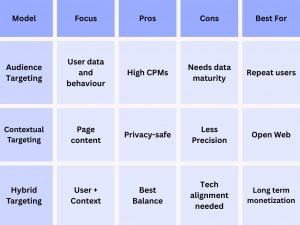
Why Hybrid Models Win in 2026
Hybrid models are emerging as the most resilient monetisation strategy for publishers because they balance performance with compliance.
- Privacy resilience: Contextual signals ensure targeting remains effective even when user-level data is unavailable
- Monetisation flexibility: Publishers can serve both brand-safe contextual campaigns and premium audience-based deals
- Better advertiser outcomes: Combining signals improves relevance, scale, and consistency across campaigns
In 2026, the winning strategy isn’t choosing sides, it’s building a flexible targeting framework that adapts to user consent, advertiser demand, and evolving privacy standards.
Monetising Audience Targeting with a Professional Ad Management Platform
The value of audience targeting is maximised only when it is properly implemented. For publishers, this implementation occurs through an Ad Management Platform, which serves as the link between insights about audiences and how they will be monetised. In the absence of this conflation, publishers who create advanced audience segments will be missing out on a large portion of their revenue.
An Ad Management Platform enables publishers to employ consistent audience targeting across direct sales, programmatic sales, and private marketplaces. Publishers will no longer need to utilise disparate tools; instead, they will have a single, cohesive solution that aligns data, inventory, and revenue strategies while allowing them to maintain complete control over user experience.
By integrating audience targeting into their Ad Management platforms, publishers will benefit in a number of keyways.
Publishers will be able to increase their CPM (Cost per 1,000 Impressions) by selling based on audience-driven demand. Advertisers are willing to pay premium rates for highly qualified and easily reachable audiences. By passing validated audience segments into the Ad Stack cleanly, publishers will be able to bundle their inventory based on the audience value of their audience rather than the placement of their pages.
Audience targeting helps publishers to sell more effectively by monetising informational traffic. Not all content is created equal for revenue-generating purposes; however, valuable audiences can often be found in low-intent or top-of-funnel pages. Audience Targeting gives publishers an opportunity to earn revenue from these visits without compromising their content strategy.
Integrated ad management reduces revenue fluctuations by allowing publishers to have a more diversified demand for advertising across contextual, audience-targeted, and direct sales channels, which makes them less susceptible to being affected by any one channel or category of advertisers.
In addition, integrated ad management allows publishers to achieve an optimum balance between their ads, their content, and user experience. Professional-level ad management platforms allow publishers to establish and maintain control of ad density, frequency, and placement at the audience level, thereby helping ensure that their monetisation efforts will not be made at the expense of engagement or trust.
In the long term, transforming audience targeting from an independent data-based activity into a scalable revenue infrastructure yields better results for the publisher in terms of establishing a sustainable revenue growth strategy, being able to adapt to changes in market conditions and maximising the lifetime value of their audience through ad management.
Privacy, Consent & Trust in Audience Targeting
Privacy is no longer a compliance checkbox; it’s a defining factor in how publishers build sustainable audience targeting strategies. As regulations tighten and user expectations evolve, publishers must treat privacy, consent, and trust as core components of monetisation, not obstacles to it.
The Regulatory Landscape
Global regulations such as GDPR have reshaped how audience data can be collected and activated. Consent frameworks now require publishers to clearly inform users about data usage and obtain explicit permission before activating audience targeting beyond essential functionality. This has increased the importance of transparent data practices and compliant technology stacks.
At the same time, cookie deprecation is accelerating the shift away from third-party identifiers. Browsers and platforms are limiting cross-site tracking, forcing publishers to rely more heavily on first-party data and contextual signals. While this change challenges legacy targeting models, it also creates an opportunity for publishers to reclaim data ownership and reduce dependency on external ecosystems.
Transparency requirements further reinforce this shift. Users increasingly want to know what data is collected, how it’s used, and why it benefits them. Publishers that fail to communicate this clearly risk losing consent, and with it, the ability to monetise effectively.
Trust as a Monetisation Asset
Trust is becoming one of the most valuable assets a publisher can own. Clear consent messaging helps users understand the value exchange between content, data, and advertising, leading to higher opt-in rates and more reliable audience segments.
Respectful targeting, avoiding intrusive or excessive personalisation, strengthens long-term engagement. When ads feel relevant rather than invasive, users are more likely to stay, return, and interact.
Finally, user-first data practices ensure that audience targeting aligns with user expectations. Limiting data collection to what’s necessary, securing it responsibly, and activating it thoughtfully builds confidence over time.
In 2026, publishers who prioritise privacy and trust don’t just stay compliant, they create stronger audiences, better advertiser outcomes, and more resilient revenue models.
The Future of Audience Targeting for Publishers
Audience targeting is entering a defining phase for publishers. As the industry moves deeper into a privacy-first, AI-driven era, success will depend less on raw traffic and more on how intelligently publishers understand and activate their audiences.
Key Trends Shaping 2026
First-party data dominance will continue to strengthen. With third-party identifiers fading, publishers’ owned data, behavioural, contextual, and declared, will become the most reliable and valuable asset in the monetisation stack. Publishers that invest early in collecting, enriching, and organising first-party data will gain a clear competitive edge.
AI-led targeting models are set to become standard rather than optional. Machine learning will power real-time segmentation, predictive intent modelling, and automated optimisation. These models allow publishers to respond instantly to changing user behaviour and maximise revenue without manual complexity.
Contextual and audience convergence will define modern targeting strategies. Rather than choosing between identity-based and context-based approaches, publishers will combine both. Context provides scale and privacy resilience, while audience insights add depth and performance, together creating more consistent monetisation outcomes.
Publisher-owned data ecosystems will replace fragmented tool stacks. Instead of relying on disconnected vendors, publishers will move toward integrated systems where data collection, consent, targeting, and monetisation operate cohesively under publisher control.
What This Means for Publishers
These trends signal a fundamental shift in priorities. Data strategy will outweigh traffic growth. Simply attracting more users is no longer enough if those users aren’t understood or monetised effectively.
Publishers will increasingly prioritise intelligence over scale, focusing on high-value segments, intent signals, and long-term audience relationships rather than chasing volume-driven impressions.
Most importantly, publishers will build sustainable monetisation systems that balance privacy, performance, and user experience. Audience targeting will no longer be a tactical add-on, but a core operational capability.
In 2026, publishers who understand their audience outperform those who simply attract it.
Conclusion
Audience targeting is no longer optional for publishers; it is a foundational requirement for sustainable growth in a privacy-first digital ecosystem. As advertising models evolve and user expectations rise, simply collecting data is not enough. The real value lies in how effectively that data is activated to drive relevance, engagement, and revenue.
Publishers that succeed are those that transform raw audience data into meaningful insights and actionable segments. When combined with a professional ad management platform, audience targeting becomes far more powerful, allowing publishers to activate segments across multiple demand sources, optimise yield, and maintain control over ad experience and performance.
At the same time, monetisation improves when relevance and trust work together. Respectful targeting, transparent consent practices, and user-first data strategies help publishers build long-term relationships with their audiences while delivering better outcomes for advertisers.
As the industry moves forward, audience targeting will continue to evolve, but its purpose remains clear. For publishers, audience targeting isn’t about reaching more people, it’s about reaching the right ones, consistently and responsibly.
FAQ:
Q1: What is audience targeting?
Audience targeting is a method of delivering content or ads to specific user groups based on shared data signals such as behaviour, interests, context, or engagement patterns. For publishers, it focuses on using first-party and contextual data to create meaningful audience segments that improve relevance, performance, and monetisation, without relying heavily on third-party identifiers.
- Helps publishers move beyond page-level monetisation
- Enables more relevant ads and content experiences
Q2: Why is audience targeting important for publishers?
Audience targeting is important because it directly improves ad relevance, increases CPMs, and supports long-term revenue stability. Instead of selling impressions based only on traffic, publishers can monetise the quality and intent of their audience, making their inventory more attractive to advertisers in a privacy-first environment.
- Drives higher yield from existing traffic
- Reduces reliance on volatile demand sources
Q3: What is an audience targeting platform?
An audience targeting platform is a tool that helps publishers collect, segment, and activate audience data across monetisation channels. It connects first-party data with the ad stack, enabling publishers to deploy targeted campaigns, optimise performance, and maintain compliance with privacy and consent requirements.
- Centralises audience data and insights
- Simplifies activation across ad platforms
Q4: How does AI audience targeting work?
AI audience targeting uses machine learning to analyse large datasets, identify behavioural patterns, and predict user intent. These insights are used to dynamically create and optimise audience segments in real time, helping publishers deliver more relevant ads and improve yield without manual rule-based targeting.
- Automates segmentation at scale
- Improves performance through continuous learning
Q5: Is audience targeting still effective without cookies?
Yes, audience targeting remains effective without cookies by relying on first-party data and contextual signals. Publishers can build compliant, privacy-safe segments using on-site behaviour, content consumption, and engagement data, ensuring relevance and monetisation even in cookie less environments.
- Reduces dependence on third-party tracking
Aligns with modern privacy standards
One Comment
Comments are closed