DSP vs Ad Network: What’s the Difference?
A DSP is a programmatic platform for advertisers to buy advertisement impressions. DSPs sell buyers ad impressions from multiple publishers in real-time, using automatic bid orders and audience data to determine pricing. An Ad Network acts as an intermediary and aggregates the inventory (available ad impressions) of publishers and buys that inventory from the publisher to sell it to advertisers. DSPs provide transparency to advertisers and publishers, but DSPs also create competition among buyers, which in many cases allows for significantly higher CPMs for publishers than Ad Networks. This guide provides an overview of how DSPs and Ad Networks function in the ad technology ecosystem and provides the reader with a better understanding of how publishers should strategically define and use these platforms to increase revenue.
Introduction: The Changing Landscape of Digital Advertising
In the last 20 years, there has been a major shift in the way that publishers monetise their digital inventory due to changes in digital advertising. In the past, publishers manually negotiated advertising purchases using an insertion order (IO) directly with the advertiser, at agreed-upon prices, and then ran the campaign using little to no automated management capabilities. Although this manual IO process allowed publishers to have control over their advertising inventory, it did not provide the scalability and efficiency that the industry has developed over the years.
With the growth of audiences in the digital landscape, advertising networks began to aggregate publisher inventory and purchase it in bulk from publishers to sell to advertisers. This created an easier demand funnel for advertisers to access inventory, but it also added complexity by creating an additional set of intermediaries that abstracted (or “hid”) the pricing, audience data, and the ability for the buyer to see who they were buying from.
Then came the move to programmatic advertising and real-time bidding (RTB), which allows advertisers and publishers to buy and sell ad impressions through computerised systems (also referred to as automated platforms), algorithms, and audience data on a very rapid basis (milliseconds). This technology was designed to bring increased efficiency, scalability, and smart decision-making to both buyers and sellers.
In today’s environment, automation and data have become the foundation of digital revenue. Advanced targeting, dynamic pricing, and machine optimisation allow publishers to maximally benefit from each impression, if these technologies are applied correctly. However, as the technologies used to access data and to automate the buy/sell processes develop, so does the degree of complexity associate with those technologies. For example, many times, Demand-Side Platforms (DSPs) and Ad Networks are spoken of and referenced interchangeably, however, there are significant differences between the two.
Therefore, this confusion poses significant hurdles for publishers because if they choose the incorrect path of monetisation, it could lead to sub-optimal yield. This means that their inventory will be undervalued and/or sold inefficiently. In addition to this limitation of revenue, publishers will have limited visibility about who is purchasing their traffic, and at what price. Excessive dependence on intermediaries may also diminish a publisher’s ability to control their pricing, access to data and execute a strategic plan for sustainable growth over time.
Additionally, if publishers want to optimise their revenue within the programmatic ecosystem, they must be able to distinguish between a DSP (Demand Side Platform) and an Ad Network, and how each of these platforms directly affects the monetisation, control and long-term growth of a publisher’s business. To navigate this complexity and maximise yield, many publishers rely on a professional ad management platform to optimise demand sources, pricing, and inventory performance across the programmatic ecosystem.
What Is an Ad Network?
An advertisement network is the intermediary between the publishers who sell their advertisements and the advertisers who purchase them. The advertisement networks purchase the leftover, unsold advertisement inventory from the publishers, package the inventory together, and sell the packaged inventory to advertisers at a premium. Rather than directly selling advertisement impressions, the publisher turns over their available inventory to the advertisement network, and the advertisement network determines the pricing, sources the demand, and delivers the inventory for the publishers. The goal of the advertisement network is to create a simple and scalable model for publishers.
How Ad Networks Work
An ad network gathers inventory from many web applications and other platforms, so advertisers can find inventory across multiple publishers. This aggregated inventory is then subdivided according to various criteria, including the vertical marketplace, geographic location, target audiences and ad types. These subdivided inventories are then compiled and made available for purchase by advertisers who would like to reach specific audiences through their advertising campaigns.
The ad network does most of the operational work of running the advertisements on behalf of the publisher. The ad network sets pricing, creates relationships with advertisers and increases the amount of revenue it can generate by using various methods. Most publishers will receive a percentage of the revenue from advertisers, and the ad network retains all other revenues generated from the purchased ad space.
Common Examples of Ad Networks
Google AdSense, Media.net and Infolinks are leading advertising networks. They provide publishers with easy implementation, high global advertiser demand and a low entry point to allow new publishers to start using them.
Why Ad Networks Exist
When ad networks began, most publishers found it difficult to connect directly with advertisers. Ad networks provided a way to generate revenue and fill up an ad request volume through providing advertisers with a way of filling their inventory through a centralised place, maintaining high fill rates (guaranteed or near guaranteed) and greatly reducing the amount of technological or operational knowledge needed to operate the network.
Ideal Use Case for Publishers
An Ad Network is typically ideal for small to mid-sized publishers, especially if they’re just beginning their monetisation journey and have limited ad ops staff. With an Ad Network, publishers can have a fast and easy way to begin generating revenue from their website, without a large amount of technical investment.
Industry insights, many of which can be found on platforms such as Publift, have stated that while Ad Networks historically helped publishers monetise their remnant inventory, there was often a lack of pricing transparency, as well as a lack of direct competition, which meant that yield optimisation is often limited, over the long term.
What Is a DSP (Demand-Side Platform)?
DSP Advertising Meaning
An example of a Demand-Side platform (DSP) is the computer programmatic platform that helps advertisers to buy advertising impressions automatically/real time in third-party publishers, ad exchanges and Supply-Side Platforms (SSPs). In contrast to negotiating separate individual contracts with every publisher they wish to work with, advertisers using DSPs can purchase impressions per impression by using the auctions provided by DSPs enabling advertisers to ensure that their advertisements reach relevant users at the appropriate time and cost.
DSPs are buyer side platforms of the overall programmatic ecosystem and have a direct impact on how much a publisher gets paid for their ad inventory.
How a DSP Works
Through centralising all aspects of media buying and managing both the buyer’s and seller’s accounts, DSPs make it easier for advertisers to purchase their desired media. Advertisers may create and define their campaign parameters by uploading their information (e.g., the creatives they would like to use, as well as other specifications related to the campaign) into the DSP while also establishing the goals they have for that advertisement. For example, they might specify the type of audience they would like to reach, how much “performance” or responsiveness they want from their audience, what return on investment (ROI)/return on ad spend (ROAS) they anticipate from the campaign, etc.
Once the advertiser has completed the setup of the campaign and the DSP, the DSP will connect with multiple exchanges and data platforms, allowing advertisers to have access to a significant number of publisher inventory pools. An auction occurs whenever a user visits or interacts with a webpage or an application. The auction allows the DSP to evaluate an impression in under a second (in the case of real-time bidding (RTB)) and determine if it will bid on that impression based on various criteria (e.g., the user’s audience data, the user’s context, the user’s device, and the user’s location, etc.).
Common DSP Examples
Leading DSPs include The Trade Desk, Google Display & Video 360 (DV360), and MediaMath. These platforms are widely used for their advanced targeting capabilities, scalability, and access to global inventory.
Who Uses DSPs
DSPs are primarily used by large advertisers, media agencies, and performance-driven brands that require precision, scale, and measurable outcomes from their ad spend.
Why DSPs Matter to Publishers (Indirectly)
While publishers are not using DSP, they play a critical role in how publishers monetise their inventory. Publishers use DSP to bring more competitive digital ad spend into the auction process, and to help DSPs provide more precise targeting to advertisers, giving them more confidence to bid higher (greater CPMs). Overall, a good marketplace of DSP provides the publisher with a higher yield on their inventory via better auction dynamics.
Ad Network vs DSP: Key Differences Explained
While Ad Networks and DSPs are both integral to digital advertising, they serve very different roles within the programmatic ecosystem. Understanding these differences is critical for publishers aiming to improve yield, transparency, and long-term monetisation control.
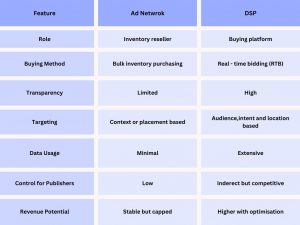
Core Comparison: Ad Network vs DSP
How the Models Differ in Practice
“The Reseller” process is the basis of advertising networks and includes aggregated Inventory from Publishers, that would normally be sitting Without ads in the publisher’s Non-Remnant, and These impressions are resold to advertisers at a predetermined or fixed rate. This is primarily a Convenience and Predictability to Advertisers and a Convenience to Publishers, as it ensures consistent Fill Rate for Publishers, but it removes the ability for the publisher to know what their Inventory is selling for in true market value and who their Buyers are. Therefore, the advertiser will have access to all advertisers and DSP’s model allows the Publisher to see the impression price they receive (through bidding), as determined by competitive auctioning process of all buyers (with available information about the seller and the products). Advertisers will be able to Bid on all available impressions and track all bids based on ‘real-time’ (the time the Impression is sold) data for purchasing impressions from other Publishers.
Transparency and Data Impact
Transparency is one of the most significant differentiators. Ad networks typically provide limited reporting, offering publishers little visibility into advertiser demand or pricing mechanics. DSP-driven buying, however, operates within open or curated auctions, allowing publishers (via SSPs) to see bid density, clearing prices, and demand sources.
Data usage also diverges sharply. Ad networks rely on basic segmentation, while DSPs leverage first-party, third-party, and contextual data to determine impression value, often resulting in higher bids for premium audiences.
Revenue and Yield Implications
From a revenue standpoint, ad networks tend to deliver stable but capped returns. DSP-driven demand, on the other hand, has a higher upside when properly optimised. As programmatic experts frequently note, DSP-powered auctions consistently outperform fixed-price network deals due to real-time competition, which pushes CPMs closer to true market value.
In summary, ad networks prioritise ease, while DSPs prioritise efficiency and data, making DSP demand a key driver of scalable publisher yield.
How DSPs and Ad Networks Fit Into the Ad Tech Ecosystem
To fully understand the difference between DSPs and Ad Networks, it helps to see where each sit within the broader ad tech ecosystem. Modern digital advertising is built on a layered, interconnected flow designed to automate buying and selling while maximising efficiency for both advertisers and publishers.
End-to-End Programmatic Flow
The advertiser, at the top of the funnel, outlines the campaign’s objectives, budget, and target audience. The DSP carries out these campaigns for advertisers by acting as the advertiser’s buying engine. The DSP evaluates available inventory and places bids based on performance goals and data for the current moment.
Ad exchanges are a real-time auction marketplace for publishers to sell their inventory. On the supply side, publishers manage their inventory through a supply-side platform to determine both inventory availability and pricing. On the Demand Side, based on user data, SSP receives and evaluates bids to be awarded to the buyer.
Once a successful bid is placed, the advertisement will be displayed on the publisher’s website and/or application almost instantly after the user requests the page.
In some cases, an ad network may serve as an intermediary between publishers and advertisers by combining inventory from different publishers for distribution and reselling to advertisers instead of participating in auctioning of each impression. Ad networks offer a package deal for their inventory instead of allowing the DSP access to them through a one-to-one relationship.
Key Clarifications for Publishers
It’s important to separate roles clearly:
- DSPs operate on the buy side, representing advertisers and optimising media spend.
- Ad Networks typically operate on the sell side, acting as intermediaries that monetise publisher inventory.
- Publishers rarely interact directly with DSPs; their exposure to DSP demand happens through SSPs and exchanges.
This distinction explains why DSPs influence publisher revenue without being tools publishers actively use.
Why Both Models Still Exist
Despite the growth of programmatic auctions, both DSPs and Ad Networks continue to coexist. Ad Networks provide simplicity, fast onboarding, and predictable fill, making them valuable for smaller publishers or unsold inventory. DSPs provide efficiency and scale, enabling data-driven competition that increases impression value.
For clarity and reader engagement, including a visual flowchart illustrating how DSPs, SSPs, ad exchanges, and ad networks coexist can help publishers quickly grasp where value and control shift within the ecosystem.
DSP Advertising: Why It Matters for Publishers
Although DSPs are advertiser-focused platforms, their impact on publisher revenue is substantial. Every bid placed through a DSP represents potential competition for a publisher’s inventory, and in programmatic advertising, competition is the primary driver of yield. When DSP demand is strong, publishers benefit even without directly operating these platforms.
Increased Competition for Impressions
DSPs connect advertisers to inventory across multiple exchanges and SSPs, enabling multiple buyers to compete for the same impression in real time. Unlike ad networks, which often set fixed or floor-based pricing, DSP-driven auctions allow impression value to be determined dynamically. This competition ensures that high-quality inventory is priced closer to its true market worth.
Higher CPMs Through Real-Time Bidding
Real-time bidding (RTB) allows advertisers to assign different values to each impression based on data signals such as user behaviour, intent, and context. For publishers, this translates into higher CPMs, especially for premium audiences. Instead of selling impressions at an averaged network rate, publishers can monetise each impression at its highest possible value.
Better Audience Matching
DSPs excel at audience-based buying. Advertisers can target users based on first-party data, contextual signals, device type, and location. When an impression matches an advertiser’s ideal audience, DSPs are willing to bid more aggressively. This precision improves fill quality and ensures that the most relevant ads appear on publisher inventory.
Reduced Price Suppression
Ad networks can unintentionally suppress prices by reselling inventory in bulk at standardised rates. DSP-driven demand, by contrast, evaluates impressions individually, reducing downward pricing pressure and allowing premium impressions to command premium bids.
The Role of Header Bidding
Technologies like header bidding (e.g., Prebid) have significantly increased publisher access to DSP demand. Header bidding allows publishers to expose their inventory to multiple DSPs simultaneously before the ad server makes a final decision. This reduces reliance on a single ad network, improves auction fairness, and increases bid density.
According to industry analyses, header bidding enables publishers to unlock DSP demand that would otherwise remain inaccessible through traditional ad networks, making it a critical strategy for sustainable, high-yield monetisation.
Ad Networks: Why They Still Matter
Despite the rapid growth of programmatic advertising and DSP-driven auctions, ad networks continue to play an important role in publisher monetisation. While they may not always deliver maximum yield, they offer practical advantages that make them relevant, especially in specific scenarios.
Advantages of Ad Networks
The integration process is typically straightforward, with ad networks only requiring a small amount of technical setup, most of the time, just a single tag or plugin is necessary, to start advertising. This allows ad networks to become accessible to publishers who do not have dedicated ad operations teams.
Additionally, ad network companies guarantee or closely guarantee inventory fill rates, giving publishers some level of assurance that their inventory will not go to waste because inventory will rarely be unsold. Publishers that may be worried about the potential for unsold impressions or sporadic demand will find the reliability of ad networks to be a benefit.
Many Ad networks also provide managed optimisation services, which include managing pricing, sourcing demand, and managing delivery and does so on behalf of the publisher. In turn, the publisher does not need to continually monitor the process and have ongoing technical expertise for this process to be successful.
Limitations to Consider
However, these benefits come with trade-offs. Ad networks typically offer limited pricing transparency, meaning publishers have little insight into who is buying their inventory or the true value of each impression. Revenue is often shared, with the network retaining a margin that is not always clearly disclosed.
Over time, this can lead to a lower long-term yield ceiling compared to programmatic auctions driven by DSP demand. Publishers also have less control over buyers, which can impact brand safety, data ownership, and strategic growth.
When Ad Networks Still Make Sense
Ad networks are particularly well-suited for new publishers who are just beginning to monetise and need a simple, low-risk entry point. They also work well for low-traffic sites, where programmatic demand may be inconsistent or insufficient to sustain competitive auctions.
Finally, ad networks can serve as supplemental demand, helping fill remnant inventory alongside SSPs and DSP-driven channels. Used strategically, they can complement a broader monetisation stack rather than replace more advanced programmatic solutions.
DSP vs Ad Network: What Should Publishers Focus On?
For publishers, the choice between ad networks and DSP-driven demand is not always binary. The right focus depends on scale, resources, and long-term monetisation goals. Understanding when each model works best helps publishers build a strategy that balances stability with growth.
When Ad Networks Are the Better Fit
Ad networks are most effective when stability matters more than maximum yield. Publishers with inconsistent traffic or seasonal volume fluctuations often benefit from the predictable fill rates networks provide. They are also a practical option when resources are limited, particularly for teams without dedicated ad operations, programmatic expertise, or engineering support.
For smaller publishers, ad networks reduce operational risk and ensure consistent revenue, even if CPMs are not fully optimised. In these scenarios, simplicity and reliability outweigh the need for granular control or advanced optimisation.
When DSP Access Should Be the Priority
DSP-driven demand becomes increasingly valuable as a publisher’s scale grows. When impression volume is sufficient to support competition, real-time bidding unlocks higher yield potential. DSP access is also critical when transparency is a priority, as it allows publishers (via SSPs) to see demand sources, clearing prices, and bid density.
Publishers focused on yield optimisation benefit most from DSP exposure. Advanced targeting, impression-level valuation, and competitive auctions enable inventory to be priced closer to true market value, especially for high-quality audiences and premium placements.
The Hybrid Monetisation Model
For most publishers, the optimal approach is a hybrid monetisation model. This strategy combines:
- Ad Networks for baseline fill and revenue stability
- DSP demand via SSPs and header bidding (e.g., Prebid) to maximise yield
By layering network demand beneath competitive programmatic auctions, publishers can ensure inventory is always filled while still capturing upside from DSP-driven competition. This balanced approach allows publishers to maintain simplicity without sacrificing performance, creating a scalable monetisation framework that adapts as traffic and resources grow.
Ad Server vs DSP vs Ad Network: Clearing the Confusion
Ad servers, DSPs, and Ad Networks are often mentioned together, which leads many publishers to assume they perform similar functions. Each platform serves a distinct role within the ad tech stack. Understanding these differences is essential to avoid misaligned monetisation strategies and missed revenue opportunities.
Core Platform Comparison
What an Ad Server Does
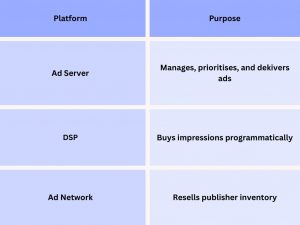
An advertisement server is the principal controller of the advertisement inventory for an internet publisher, including Google Ad Manager. The advertisement server determines what advertisement will be displayed to a user at what time and in what location according to pre-established rules, priorities, and sources of demand (i.e. for ad placement). What is critical to understand is that advertisement servers do not purchase advertisements; they deliver them as directed by the owner of the advertisement inventory using information from (i) a variety of networks, (ii) direct business arrangements between the publisher and an advertisement buyer, (iii) supply-side platforms (SSPs), and (iv) programmatic auctions.
The Internet Publisher Uses the Advertisement Server for All Yield Optimisation Logic, Including, But Not Limited To, Price Floors, Line-Item Prioritisation, and Header Bidding Integration.
What a DSP Does (and Doesn’t Do)
The ad-buying function is the only function DSPs are supposed to provide; DSPs allow advertisers to buy ad impressions from multiple exchanges and SSPs using automation and real time data. DSPs do not serve ads on publisher pages or manage inventory, and they do not have the ability to access ad impressions directly. Therefore, the only reason publishers see DSPs is when they receive bids from them from their ad inventory via exchanges and SSPs and the competing for ad impression auction.
What an Ad Network Does
An Ad Network sits closer to the sell side. It aggregates publisher inventory and resells it to advertisers, often at fixed or averaged prices. Unlike DSPs, ad networks do not participate in real-time impression-level auctions. Instead, they operate on bundled inventory and predefined pricing models.
Why This Distinction Matters
Confusing these roles can lead publishers to rely on the wrong tools for the wrong goals. Recognising that ad servers manage delivery, DSPs drive demand competition, and ad networks provide simplified resale ensures publishers design monetisation strategies that maximise both control and revenue.
The Future of Programmatic: Moving Beyond Ad Networks
Programmatic advertising continues to evolve, and with it, the role of intermediaries is being redefined. While ad networks once played a central role in publisher monetisation, industry trends are increasingly shifting toward greater efficiency, transparency, and direct demand access.
Key Industry Trends Shaping Programmatic
Demand Path Optimization (DPO) represents a significant disruption in the programmatic advertising ecosystem. Advertisers are increasingly cutting out unnecessary hops between DSPs, exchanges and intermediaries – which helps them save money by reducing fees and likewise improving advertising efficiency. This shift is facilitating greater access to publisher inventory, and in many cases circumventing traditional ad network layers in a more direct and efficient manner.
Unified auctions are also developing – whereby all demand sources for inventory (including direct deals, programmatic partners and DSPs) compete against each other within the ad server in real-time. This method removes artificial prioritisation and awards inventory to the highest bidder, at the time of the auction.
The way advertisers are targeting audiences will continue to impact the programmatic advertising ecosystem. With the reduction of third-party cookies, advertisers are shifting towards using contextual signals, first-party data and publisher audiences as their main methods for targeting audiences, whilst DSPs have adapted to the changes that are taking place in this area by providing greater value to premium publisher inventory during open auction.
Lastly, publishers have standardised the use of direct DSP access through Header Bidding. Through header bidding, publishers can expose inventory to multiple DSPs simultaneously – increasing the volume of bids being submitted and decreasing reliance on fixed pricing bundles offered by ad networks.
What This Means for Publishers
These trends represent an opportunity for publishers to gain more control over their pricing, data, and relationships with their buyers by reducing their reliance on intermediaries. By minimising the number of steps between the buyer and seller, auctions become much more efficient, with a larger percentage of advertisement spend going directly into the hands of inventory owners. Publishers will have the best opportunity to attain a higher level of efficiency and yield if they leverage DSP-generated demand and modern auction approaches in the future as advertisers continue to prioritise the purchase of transparent, high-quality supply paths.
The future belongs to publishers who understand their demand sources, not just connect to them.
Conclusion
With the rise of digital advertising, there are now more ways for Publishers to monetise their content. However, it also comes with a lot of responsibility as there are now many options to choose from but also come with the increased potential to make mistakes if you’re not familiar with what each option represents. In many cases, Ad Networks are still a fundamental way for Publishers to monetize because they make it easy for Publishers to monetize their content, give them easy access, help manage their ad inventory for optimisation, and provide reliable fill rates, providing stability for Publishers with inconsistent traffic or limited resources.
At the same time, Demand Side Platforms (DSP) offer an optimised approach to programmatic advertising. DSPs bring together real-time bidding, advanced targeting and data-driven decision making, which allows the creation of demand that maximises CPMs and creates more accurate valuation of impressions than what was previously available to Publishers through Ad Networks. Even though Publishers do not directly deal with DSPs as part of their monetisation process, DSPs still heavily influence the overall yield on Publisher inventory, and they offer much more transparency regarding the competitive nature of an auction process than Ad Networks.
Both models are of value to Publishers, but the most important factor in determining publisher monetisation strategies is how the publisher approaches the use of both tools. Publishers that only use Ad Networks run the risk of sacrificing their long-term growth potential to create meaningful revenue, while Publishers that leverage both Network demand and DSP exposure by integrating them with SS Partners (SSP) and Header Bidding can position themselves for sustainable and scalable growth.
Therefore, understanding the key differences between DSPs and Ad Networks is essential for all Publishers that are serious about generating sustainable revenue over the long term. By leveraging a professional ad management platform, publishers can effectively balance Ad Networks and DSP-driven demand to achieve greater transparency, higher CPMs, and sustainable long-term revenue growth.
Frequently Asked Questions
Q1: How does a DSP differ from an Ad Network?
A DSP (Demand-Side Platform) allows for advertisers to purchase advertisement inventory for real time delivery through an Automated Bidding process; The determination of how much advertisers are willing to pay for every impression using data to determine value. In contrast, an Ad Network pools together available publisher inventory and resells to advertisers based on fixed or average pricing. Therefore, the main difference between a DSP and an Ad Network is in the pricing of inventory: dynamic bidding versus static or combined pricing.
Q2: Do publishers use DSPs?
No. Publishers are not able to work with DSPs directly. Rather, DSPs provide demand for the publisher’s inventory through an intermediary vendor called SSPs (Supply-Side Platforms), Ad Exchanges & Header Bidding methods such as Prebid. From the perspective of a Publisher, DSPs are treated as competing advertisers to whom the Publisher submits bids on their behalf; the Publisher does not have any day-to-day control over DSP activity.
Q3: Are Ad Networks now old fashioned?
Although Ad Networks (or Ad Networks) are not considered “old fashioned” anymore, the function of a network has transformed over time. Compared with their more modern and programmatic counterparts, Ad Networks offer significantly less flexibility and visibility into inventory available for sell and typically expose a publisher to less than optimal return on investment due to how inventory is sold (fixed vs dynamic). That said, Ad Networks do serve niche functions; Specifically, Ad Networks provide guaranteed fill, a source of supplementary revenue for less mature publishers, and represent demand that accompanies programmatic purchasing.
Q4: What is the function of an ad server?
Ad servers are responsible for determining when, where and how advertisements will be displayed on a publisher’s website or mobile application. They do not participate in the buying or selling of advertising inventory but rather select which demand source is awarded the impression according to preset rules and protocols of priority, as well as the outcome of auctions.
Q5: Are publishers able to use both DSP and Ad Network advertising?
Publishers typically employ a combination of advertising networks as well as DSPs as a hybrid advertising strategy. Using Advertising Networks as base fill along with utilizing DSP-based demand through SSPs and header bidding increases transparency, competition and ultimately increases publisher revenue.