What Is In-App Advertising?
In-App Advertising refers to displaying advertisements within mobile applications (apps). This type of advertising allows app publishers to profit from the users’ engagement with the app, without charging users for the use of the app itself. In-App Advertising is different from Web Advertising; the latter utilizes a desktop environment; the former utilizes a Mobile SDK (software development kit) and therefore is designed specifically for Mobile Devices and the pattern of user behaviour as it relates to Mobile Devices.
The way in which In-App Advertising works is by linking the App’s inventory with an Advertiser through an Advertisement Network, an Advertising Mediation Platform, or using Programmatic Advertising Auctions. When a user opens or interacts with an app, the app generates a request for the Ad and the Advertisers place bids in real time for the opportunity to display their advertisements based on the bidding criteria set forth for the ad.
For publishers, In-App Advertising can provide considerable revenue potential because it offers Apps the ability to build large audiences that engage with the App. Advertisers also receive high levels of engagement through In-App Advertising formats, and each of these formats can provide unique revenue opportunities to publishers. In summary, this guide provides a comprehensive overview of In-App Advertising, key formats, revenue models, and the strategies publishers can implement to maximise revenues while providing a positive user experience.
Introduction: The Rise of In-App Advertising
In the last decade, the way we use our mobile phones has changed fundamentally. Mobile applications have surpassed mobile web as the primary way for people to access digital content. Users spend most of their time on their phone by using apps rather than the web browser. This shift is the result of many things, such as ease of use, customisation of the user interface, and the ability to experience a more fluid experience using an app compared to the web. Because of the increased usage of mobile applications, users have also changed the way they interact with content and therefore, the way content creators can monetise their content.
One of the main contributors to the popularity of mobile apps is that users who frequently use an app often engage with the app more often and regularly return to the app daily. Push notifications, user preference storage, and a native user interface design create a habit-forming experience for users; however, many mobile websites struggle to create this same experience. For content providers, an app provides many more ways to connect with users, create more impressions, and create many more opportunities to generate revenue (when monetised correctly).
Originally a model where users were required to download apps to access their content, the mobile app economy now operates around the idea that users want to be able to interact with the apps on their device for free. This change has seen a shift in how most apps in the gaming, utility and other types of content categories are monetised; instead of charging users for the app itself, most are monetised using an advertising-supported model. There are still important opportunities through in-app purchases and subscriptions; however, they typically convert a small percentage of users into buyers, making them less scalable and leaving a large amount of revenue untapped.
To generate monetisation from the increased traffic coming from their growing user base, the in-app advertising model is becoming a more significant source of income for a wide variety of app developers and publishers. Even though publishers have discovered the value of this type of revenue source, many still lack an in-depth understanding of the way in which they work, the methodology behind advertising pricing and optimising both revenue and user experience. Without proper execution, publishers may find themselves with low fill-rates, eCPM rates and customers who are dissatisfied with their applications.
To promote long-term viability of in-app advertising revenue, it is essential that publishers first gain a complete comprehension of what in-app advertising means, and how the entire in-app advertising process works. To accomplish this, it is advisable to either contact an online publisher network or form an alliance with a professional ad management platform that has a proven track record in establishing a balance between maximising revenue and enhancing the end user’s overall experience.
Detailed meaning of In-App Advertising
Mobile Ads are ads displayed through a mobile app that allow app publishers to generate revenue from impressions, clicks/installs or other user actions, without charging the user at the time of app download. This type of advertising enables publishers to monetise their apps by integrating advertising technology within the app, allowing advertisers to engage the user while they interact with the content or play the game. For app publishers, in-app advertising creates a recurring revenue stream based on the continued usage of the app as well as providing a scalable revenue model.
In contrast to traditional online advertising, in-app advertisements use embedded software (SDK) in mobile applications instead of using ads through a web browser. With the addition of SDK technology, advertisers can receive device-level signals such as operating system, device type, app category, and usage patterns. This information allows advertisers to provide more targeted, contextually relevant, and performance-focused ad content than what they typically would be able to offer through mobile web advertising.
User Experience (UX) is a major difference between the app and the mobile Web. In-app advertisements are structured for a user interface (UI) that enables users to touch and swipe; therefore, all advertisements are formatted for swiping, tapping, and interacting with an app in a full-screen experience that allows the user to feel that the advertisement has been incorporated into their user experience, not as an intruder.
The primary reason for using an in-app advertisement is to assist publishers who provide free apps to their users. With users becoming more reluctant to pay for downloading apps, in-app advertisements provide a way for publishers to increase revenues based on the number of active users and the length of each user’s session. As a result, in-app advertising can be used for any type of mobile app, including gaming apps, content platforms, news, and lifestyle apps. Whether your app has the potential to reach millions of unengaged users or a smaller number of highly engaged users, the in-app advertising approach can be effectively scaled to reach either user group.
In-app advertising is the most effective way for publishers to monetise their apps because: (1) they provide mobile-first services that can be used repeatedly, retain users over long periods of time, and allow for high levels of engagement; and (2) in-app advertising provides publishers with a higher level of customer engagement in a controlled environment compared to the mobile web, making it one of the most reliable monetisation methods for today’s app publishers.
How Does In-App Advertising Work?
A real-time, highly automated environment in which individuals are transported from one digital endpoint to another via an App allows for real-time delivery of Ads. Although this experience seems to be seamless from the user’s perspective, there are several systems that work together to ensure that the right Ad is delivered at the optimum time and price.
It begins with the user either opening the App or responding to an in-App action (i.e. changing screens, finishing a level in a game, or scrolling through their feed). Once this occurs, the App sends an Ad request through the integrated Ad SDK. This Ad request supplies context about where the user is and includes other context-based parameters including the App ID, the type of Ad placement, device type and an operating system, and were allowed by the Platform Policies, anonymized User data.
The Ad request will be sent to the Ad networks and mediation platforms, or Ad exchanges, that the App relies on for Ad inventory. Mediation platforms take on a critical role by uniting multiple demand sources under one umbrella, enabling Payments to ask those Demand Sources for the impression. Depending upon the structure set up by the App and Mediator, the request can either follow a traditional waterfall setup that sends out the request to the Demand Sources in the order the App desires or follow an RTB setup whereby multiple Ads can be offered to the App at once for real-time competition.
Advertisers participate in a real-time bidding process for an impression within milliseconds in an RTB environment. Demand is typically from DSPs that are running programmatic campaigns. DSPs evaluate impressions from user signalling, application context, and historical performance. The impression goes to the highest qualified bidder, which allows the publisher to achieve maximum yield from that single impression.
After the winner has been determined and the auction completed, the winning ad creative is instantly delivered back through the SDK and rendered on the device. This process, from ad request to ad render, is fast enough that the user does not experience any lag between these two points, which helps maintain both the performance and the user experience of the app.
The success of this ecosystem is dependent on a combination of the main components which allow it to function smoothly. The app SDK provides a mechanism for making ad requests and rendering ads; ad networks provide aggregated advertiser demand; mediation platforms offer a means of optimizing the number of competing bidders for a given ad network; and lastly, DSPs provide programmatic bids to advertisers at scale. In addition, compared to web-based programmatic, in-app RTB occurs more quickly and is less susceptible to various environmental issues. Because of the ability to target devices at the device level, and the ability to deliver consistent performance over time, these systems allow advertisers to optimally fill their inventory, maximize eCPMs, and gain long-term revenue from in-app advertising.
In-App Advertising Formats Explained
The various formats for advertising inside apps are designed to provide a balance between how much money the advertiser can make versus how disruptive it is to have the ad in the user’s experience. Choosing the perfect mix of the various formats is important so that the application makes the most revenue without disrupting the users’ engagement or retention with the app.
A common in-app advertising format is banner ads. Banner ads are rectangular and small and usually appear on the upper or lower part of the app screen. As users go through their content, the banner remains on the screen for the user to see. Banner ads generally have a lower CPM than other types of ads, but they provide a high level of viewability while providing an abundance of impressions to the advertisers. Banners can work very well in applications that have large amounts of content and where constant visibility of the banner ad will not interfere with the user’s ability to navigate the content.
Interstitial ads are ads that take over the entire screen of the application and are typically displayed during natural transitions within the application, such as going from level to level in a game, loading a new page, or ending a session and starting a new session. Since interstitials are full-screen ads, they provide a higher level of visibility and higher CPMs compared to banners. Timing is important with interstitial ads; if they are not displayed at the right time or place in the app, then interstitials could create a negative experience for the user, and this could affect retention rates.
Rewarded advertising is the most accepted type of advertisement within apps. It allows users to willingly view a video or engage with an advertisement in exchange for rewards including in-game currencies, additional lives and/or access to premium content within the application. Because the user is voluntarily engaging, rewarded ads tend to have higher engagement rates, completion rates and overall revenue performance when compared to other ad formats. Rewarded ads are especially effective for app developers who create gaming applications, but they are now becoming increasingly more common for app companies with non-gaming apps as well.
Another advertisement format is native advertising, which is designed to fit seamlessly within the user interface of the application, matching the look and feel of adjacent content. Instead of being viewed as a typical advertisement, native placements are presented as suggested content or sponsorship/partnership listings. Because they do not take away from the user experience, native advertising has proven to have a better click-through rate than standard display or banner advertisements, especially in news or lifestyle applications, as well as in content-rich applications.
Playable advertisements are often only found in the gaming environment and allow users to try out a short interactive preview of another application or video game before downloading it. The interactive previews provide advertisers with an extremely high conversion rate, since the user can experience the product prior to making a commitment. As a result, playable advertising has become a grow in demand by performance-driven advertisers.
According to the latest figures presented by the industry, it is evident that rewarded and native advertising formats are outperforming traditional banner ads for in-app (mobile) content revenue. Publishers should therefore place priority on these high-engagement advertising formats along with the strategic placement of banner and interstitials to maximize monetization potential while at the same time providing the best possible user experience.
In-App Advertising Revenue Models
Revenue from in-app advertising is obtained through a variety of pricing models that compensate publishers for different ways that users interact with ads. By knowing how each of these models works, publishers can develop monetization strategies that are most appropriate to their app category, their audience behaviours and their level of user engagement.
The CPM model (Cost Per Thousand Impressions) is the most used model for publishers. It allows publishers to generate revenue every time an advertisement is shown to users a total of 1,000 times, regardless of the level of interaction each user has with the advertisement. Typically used for brand campaigns and for use with premium advertising formats such as Interstitials, Rewarded Video and Native High-Impact Ads, CPM provides a reliable and scalable revenue stream for publishers who can generate high levels of engagement and a large number of viewable ads.
In contrast, the CPC model (Cost Per Click) compensates publishers based upon a user’s click-through to a website from an advertisement. The CPC pricing model is performance-driven and is typically used primarily for Native and Banner Ads. The CPC pricing model generates less revenue per impression than CPM but has been shown to perform well in applications with a highly engaged user base or a targeted or niche audience.
The CPA or Cost Per Action model is primarily outcome driven. Publishers derive revenue strictly from actions completed by each User such as completing an app download, signing up for something, and/or making a purchase. CPA campaigns have become increasingly popular place within the Gaming and App Install advertising segments, as advertisers are placing a key emphasis on measurable conversion results. The average CPA payout per action is higher than other models, however, total revenue generated will still be highly dependent on the quality of Users and the conversion rates achieved.
When considering the factors that can affect the amount of revenue Publishers will generate through In-App Advertising, Geographical regions are one of the biggest influencers as the so-called “Tier 1 Markets” will have a higher average CPM than other tiers. The rate of User Retention and Session length also influences the total volume of impressions available for publishers. Though the mix of the Ads Formats used by the Publisher is another critical component in determining revenue generated. Generally, high-impact formats, such as rewarded ads and native format ads, tend to provide stronger returns than others. Consequently, the fill rate (i.e., the percentage of ad requests filled) will affect revenue for Publishers, especially those with a global audience.
In general, revenue generation patterns in gaming apps and those that are not games can be quite different. Rewarded ads are instrumental in gaming apps to enhance voluntary engagement with Users and maximise the lifetime value of each User. Conversely, the goal of non-gaming apps (news, content and utility) is to provide a seamless integration of native and interstitial ads into the established habits of Users. Understanding these differences allows publishers to optimise in-app advertising revenue without compromising user experience.
In-App Advertising vs Mobile Web Advertising
Although both in-app advertising and mobile web advertising serve the purpose of generating revenue for the mobile user base, they have significantly dissimilar operating environments. Therefore, it is essential for publishers to understand the varying operating conditions associated with each advertising method for them to determine how best to generate revenue from mobile users along with providing a good user experience.
Below is a high-level comparison of the two models:
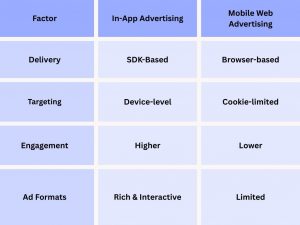
In-app advertising is typically delivered directly to mobile applications via embedded SDKs. Because ads can load faster, load more consistently, and integrate better into the interface of mobile applications, this delivery method is more efficient and effective. Conversely, mobile web advertising relies heavily on browser-based ad tags. This means that the ads are subject to many delays, inconsistencies in how they are rendered, and restrictions placed on them by browsers.
Another distinction between in-app advertising and mobile web advertising is how targeting is performed. In-app advertising uses device-based signals to identify the user, such as the user’s operating system and device type, the app category, and contextual usage patterns. In contrast, mobile web advertising relies primarily on cookies and browser identification numbers to track user behaviour. However, because of privacy laws and regulations and the changing landscape of Internet browsers, both methods are becoming increasingly less reliable. Thus, in-app targeting is becoming more robust and successful for advertisers. Therefore, advertisers can expect to have stronger demand and higher CPMs than with mobile web advertising.
Additionally, user engagement statistics are also more favourable in in-app advertisements. On average, users spend more time on mobile apps than they do on mobile websites. Consequently, users tend to spend more time in longer sessions and engage more frequently with in-app ads. Moreover, apps have a wider variety of rich and interactive ad formats, including rewarded videos, playable ads, and immersive native placements. In contrast, mobile web formats offer limited options for rich and interactive ad placement.
The advantages of in-app advertising over mobile web advertising can be summarized as follows:
- More than 95% of mobile users have protection against advertising (blockers) when using their mobile devices.
- In addition, the use of technology and analytics tools allows publishers to better manage their ad inventory, create unique user experiences and provide advertisers with higher quality, uninterrupted impressions.
- In-app advertising allows for greater control over the user experience, as ads can be integrated seamlessly into the app, whereas mobile web ads are typically placed in between content pages, resulting in interruptions.
Therefore, for publishers focused on monetisation and long-term growth, the use of in-app advertising represents a more scalable, predictable, and profitable way to monetise mobile web content compared to mobile web advertising.
Monetisation Stack for In-App Publishers
A successful in-app monetization strategy includes a comprehensive technology stack that generates demand for and efficiently yields the greatest amount of ad revenue, makes performance metric data easily accessible to every party involved in the transaction and through analytics reporting to allow for the tracking of various metrics related to performance, overall revenue, etc.
To generate demand for impressions and stabilise revenue stream in these volatile economic marketplaces, a vast majority of mobile app developers will not rely solely upon one monetization platform but instead will use various monetization services to create competition for every impression throughout their application.
These foundational services include such things as advertising networks, AdMob, Unity Ads, AppLovin, etc., that act as intermediaries between the publisher and the advertising demand and have access to virtually all of the available types of in-app advertising formats , banners, interstitials, rewarded videos, playable ads, etc. The use of a single provider will limit the volume of demand that can be accessed and increase the volatility of the revenue stream for advertisers.
To overcome this issue, app developers typically leverage a mediation service that serves as an intermediary between the application and several advertising networks and ultimately manages how advertising request routes and optimizes ad requests from multiple advertising networks. Modern day mediation services offer clients both traditional waterfall and incentivised bidding options, allowing different demand sources to compete against one another, that is, based upon how they performed historically as well as how well they perform in real time.
Through this competition, app developers will experience an increase in their effective CPMs and fill rate across multiple regions or demographics.
Programmatic exchanges are a way for demand to grow through DSPs having access to the ability to bid on impressions at large scale. The ability for deep-pocketed advertisers to compete with networks leads to increased yield for each of those impressions. For publishers with engaged user bases, programmatic access is of great importance and finding ways to enable competition among networks to drive that access will lead to better ROI.
Publishers also benefit from having access to the analytical and A/B testing tools available through the various programmatic marketplaces. Through analytics, publishers can track metrics such as retention, session length, eCPM, fill rate, and lifetime value all of which can be monitored to help them determine which ad formats, placements, and frequency caps will provide the best monetisation strategy for their audience.
Publishers will face one of the biggest strategic decisions when they choose mediation or a single network approach. While single-network implementations may be easier to set up and operate, they create dependencies on a single source for pricing and revenue generation, thus limiting a publisher’s ability to optimise their yield. Mediation provides an advantage over single-network platforms by allowing multiple sources of demand to compete for each impression, thus reducing the reliance on any one source. Ultimately mediation enables publishers to mitigate the risks that are associated with revenue fluctuations that occur as a result of changes in seasonal demand and/or advertiser budgets.
Based on more than a decade of data in the industry, we have found that allowing publishers to leverage mediation maximises revenue opportunities by allowing them to create a competitive environment for advertisers to invest in and mitigate potential revenue volatility. If you are an in-app publisher interested in developing a sustainable scaling strategy, then you must build a diverse monetisation stack to support that scalability.
In-App Advertising Best Practices for Publishers
Using In-app advertising successfully isn’t only about Increasing Impressions but also Maximizing Revenue while Maintaining User Experience & Long-Term User Retention. Publishers following best practices outperform those that put User Usability at risk to gain short term revenue from increased advertising impressions.
One of the key principles of In-app ad optimization is balancing user experience with advertising. In-app ads should be inserted into the app at a point where it makes sense to do so, like during a screen transition or following an action being completed within the app, rather than inserting ads in the middle of the flow of app usage. If users feel like they’re being interrupted by a lot of ads, they will be more likely to stop using your app, which decreases LTV and overall revenue.
Another important aspect to consider is frequency capping. Showing an ad, too many times creates ad fatigue, which causes users to stop responding to it because they have seen it so many times. By placing respect on how often users see ads (particularly interstitials & videos), you can achieve much higher completion rates and CPMs than if users are bombarded with your ads repeatedly over time.
You must regularly test different ad formats. Performance will vary depending on the user, geography, and app category, so there’s no one-size-fits-all for ad format placement. By A/B testing different ad formats, placements, and reward values, you will be able to find the combination of ad format that delivers the highest yield without hurting retention rates. You must use this data to continuously improve your ad placement and format as advertiser demand and user behaviours continue to change.
Segmentation allows publishers to identify specific groups of users based on their behaviours, including frequency of session usage, amount and depth of engagement in a session, and their purchasing history, and around those behaviours, they can provide better tailored advertising experiences. Users who are highly engaged may respond well to ad formats, such as rewarded ads. Conversely, lighter users may have a higher risk of churn when exposed to ad formats that are too intrusive.
Publishers should also avoid certain pitfalls when creating their in-app advertising strategies. For example, placing too many interstitial ad units can lead to a rapid decrease in user experience and retention rates, while ignoring retention metrics in favour of generating short-term increases in eCPM often results in an overall decrease in revenue over time. Additionally, relying solely on one source of demand to fulfil advertiser needs can put a publisher at risk of sudden drops in fill rates and/or pricing levels.
By implementing the best practices and strategies outlined above, publishers can create a sustainable long-term revenue stream through their in-app advertising efforts while maintaining user engagement and loyalty.
Privacy, User Experience & Compliance
The importance of user privacy and experience has never been greater in the marketing world than it is today. The global nature of the marketing industry has put increasing pressure on publishers to comply with local and international regulations regarding the collection of personal data while still generating adequate revenue through monetisation.
One of the most significant changes in the last few years has been the implementation of App Tracking Transparency (ATT) by Apple. Specifically, ATT requires apps to first gain the user’s express consent before tracking their activity across other apps and websites. Because of the reduction in access to device identifiers for opted-out users, it is now essential for iOS publishers to leverage consent-based data collection and contextual advertising.
Additionally, GDPR and other regulatory frameworks dictate how user data is collected, stored, and processed across international borders. As a result, publishers are required to provide users with written notification detailing how any collected data will be used and obtain the proper consent when necessary. Having a compliant consent management platform (CMP) in place is critical in ensuring compliance with regulatory requirements while also fostering advertiser confidence. Further, having an accurate consent signal will assist demand partners in accurately evaluating and bidding on the publisher’s inventory.
First-party data has become strategically important as third-party identifiers will become less reliable with time. The ability to identify user engagement through the app and identify content preferences; session behaviour; etc., enables publishers to optimise the delivery of ads in compliance with privacy rules. First-party data can also improve segmentation or contextual relevance and monetisation outcomes.
From a user experience perspective, privacy-first monetisation strategies help to enhance the overall user experience. Rewarded ads are designed to be opted into by users and allow the users’ users to have control over when and how they engage with advertising. This type of consent-based interactions leads to a higher rate of completion and higher performance by advertisers.
Moreover, native ad placements are usually designed to fit seamlessly within the overall app design and functional flow and, therefore, feel less like interruptions. In content-driven apps, this is even more pronounced, as native ads reduce friction for users. Conversely, poorly timed or aggressive advertising placements can lead to user frustration and increased churn.
By shifting to a privacy-compliant and UX-first monetisation model, publishers build trust, protect long-term retention, and create a sustainable in-app advertising strategy based on current regulations and platform standards.
The Future of In-App Advertising
Since technology and privacy standards and user expectations are constantly changing the mobile ecosystem, the evolution of in-app advertising has been happening at a rapid pace. Those who adapt early will position themselves well for the foreseeable future and develop sustainable, scalable and effective monetisation strategies.
Global demand sources are now competing simultaneously and in real-time through mobile bidding, which is perhaps the largest industry shift. Bids create more transparency while maximising yield by allowing multiple demand sources to compete for each impression. With the ongoing trend of more ad networks and exchanges supporting mobile bidding, and the resultant inefficient utilisation of waterfalls, publishers looking for large-scale stable revenue in global markets will no longer find that waterfalls give them the competitiveness. Privacy-first targeting, the migration towards compliant data usages, with restrictions on the use of device identifiers and third-party tracking, was a catalyst for the recent development in the industry. Advertisers now rely more heavily on using contextual signals (app category, content type, session behaviours, and time of day) to support targeting and optimisation, rather than using IDs. As a result, publishers who understand their audiences well will benefit from targeting based on contextual relevance to what users are using and when they are using it. There will also be an emphasis placed on the publisher’s ability to provide inventory that meets the descriptive values of contextual meaning.
Hybrid Monetisation is a new trend where in-app advertising is coupled with in-app purchases (IAPs) and subscriptions. This means that rather than picking one or the other as their primary source of revenue, many publishers are combining both types of monetisation to give their users more choices and capture the maximum lifetime value from their customer base. A good example of hybrid monetisation is with rewarded ads, which provide users with something of value in exchange for completing an engagement task, thereby bridging the divide between free and paid content experiences.
For publishers, hybrid monetisation presents real advantages. By combining sources of demand with their own pricing policies, they can have better control over their own revenue, creating a more stable revenue model, while providing advanced targeting strategies allow for smarter and more relevant advertising experiences rather than interrupting users during their experience. Monetisation decisions are increasingly tied closely to overall product design, retention, and engagement, rather than being determined solely by the placement of ads.
In summary, future success with in-app advertising will be the domain of those publishers who approach monetisation as a strategic business decision, rather than simply another source of revenue through ad space sales.
Conclusion
In-app advertisement represents the most important thing to happen to the monetisation of mobile devices today. As users continue to shift from a predominantly web-experienced world to an app-experienced world, monetisation of mobile devices will continue to be achieved using applications. Compared to the Mobile Web, Applications have proven to have higher engagement, longer session times, and more consistent usage. Therefore, the Application will continue to be the preferred method for monetisation of Applications using advertising as a means of revenue generation.
Publishers need to understand what different formats for IAA(IAAs) means and how different revenue models (such as CPM, CPC and CPA) operate. There are also several other factors surrounding geography, retention, and session depth that affect total earnings of publishers monetising mobile devices through in-application advertisements. Therefore, even with high traffic volumes, a publisher may have an opportunity to monetise effectively using in-app advertisements.
Publishers should also maintain the balance of user experience and revenue scaling. While aggressive advertising strategies may increase short-term profitability, these strategies can negatively impact long-term retention and lifetime value of the users. Publishing with an experienced ad management platform will allow a publisher to optimise demand, pricing and selection of advertising formats while maintaining a high user experience.
Publishers need to learn and understand how in-application advertisements operate; therefore, learning how to master the process of in-application advertisement monetisation is a must; this will provide the publishers with a solid foundation for continued success in mobile revenue.
Frequently Asked Questions (FAQ)
Q1: What is in-app advertising?
In-app advertising refers to ads shown inside mobile applications that allow publishers to generate revenue while offering free access to users.
Q2: How does in-app advertising work?
Ads are delivered through SDKs integrated into apps and sold via ad networks, mediation platforms, or real-time programmatic auctions.
Q3: Which in-app ad format earns the most?
Rewarded ads typically generate the highest CPMs due to voluntary user engagement and high completion rates.
Q4: Is in-app advertising better than mobile web ads?
Yes. In-app advertising generally delivers higher engagement, stronger targeting, and more reliable monetisation than mobile web ads.
Q5: Can small apps earn from in-app advertising?
Yes. Even smaller apps can generate meaningful revenue by using mediation, optimising formats, and leveraging rewarded advertising.