Introduction
Video ads are a growing source of income for content creators due to the rapid increases in revenue from the digital advertising marketplace. As viewers continue to gravitate toward short-form video and other high-impact content types, advertisers will respond by increasing their budgeting for video while offering significant growth potential for publishers to generate additional revenue streams. To best benefit from these increasing levels of investment in video ad formats, publishers must also ensure they have the necessary technical infrastructure in place to successfully deliver their video ads. Instream and outstream advertisements are two of the more widely used ad formats that are powering the monetization strategies of many publishers today.
Each of these ad formats presents new opportunities for revenue generation for publishers, however, they differ from one another significantly, each providing a unique user experience, requiring technical and content readiness levels at various levels. Therefore, the selection process between in-stream and out-stream ads can often be difficult for publishers as the environment for video advertising continues to become increasingly complex and competition for viewers’ attention increases.
Given that publishers are faced with the question, “Which type of video advertisement is a better fit for my audience?”, understanding the dynamics and characteristics of the two primary video advertisement formats is critical to maximizing revenue per thousand (RPM) associated with each advertisement format, ensuring a positive user experience, and optimizing revenue generated from demand partners.
When publishers utilize a professional ad management solution like Newor Media, it can provide a publisher with a combination of in-stream and out-stream advertisements leading to enhanced fill rates, increased advertiser competition, and a more predictable source of revenue.
What Are Instream Ads?
Instream ads are a type of video ad that appear within real video content, and therefore they are the most typically seen format for ads in the digital world. Instream ads may be specific to the user – such as “pre-roll”, when the user is playing the video, “mid-roll” when the user is in the middle of viewing a video, or “post-roll”, when the user has finished viewing a video. Since instream ads align with the way many users view videos, they can produce higher levels of engagement, completion rates, and CPMs than other types of ads.
The most recognized provider of instream ads is YouTube. YouTube is a video platform that provides a variety of videos and is a large source for advertisers to reach their target audiences through instream ads. Many streaming services, publishers of news with a defined focus on video content, and entertainment websites use instream advertising to monetise their assets; advertisers value the attention of users who are “actively” engaged in a video and therefore provide a significantly higher value to advertisers.
Here’s how instream ads function:
To sell instream ads, publishers need to have both a video player and qualifying video content to serve to their consumers. Video players generate ad requests, signifying to advertisers and ad networks that there is an available ad slot (pre-, mid-, or post-roll). Video creatives will be on-hand from the server or demand partners and must adhere to specific requirements for the publisher to achieve any meaningful level of revenue.
For the most part, instream ad formats are served using VAST and VPAID tag technologies, and thus it is imperative to have quality, consistent output of video content from the publisher to produce substantial growth in revenue.
Because instream ads depend entirely on video inventory, they work best for publishers who produce:
• Regular video content
• High-quality, long-form or short-form videos
• Tutorials, news clips, interviews, product demos, or entertainment videos
In short, instream ads are ideal for publishers with a video-first strategy or those who can maintain a steady library of video assets. They deliver some of the highest returns in video advertising but require real commitment to consistent video production and proper player implementation.
What Are Outstream Ads?
Outstream ads are a form of video advertising that can be displayed outside of a typical video viewing environment, providing flexibility for publishers who do not create their own videos. Outstream ads do not require a video to accompany them, but rather can be included in digital content, such as articles, between paragraphs, in mobile feeds, or in sidebars. These ads will automatically start playing on mute upon displaying, allowing for smooth blending into the surrounding content.
One specific example would be the mute autoplay videos sometimes featured in news articles or blogs. An outstream ad expands into full size once visible and collapses straight away once the user scrolls down, allowing for a non-obtrusive and mobile-friendly experience. Because an outstream ad does not disrupt any existing video content, it can easily be fitted into an online publication without causing a disruption to the user’s browsing experience.
Thus, how outstream units’ function:
Outstream units are like stand-alone video placements; they don’t need a video player or a collection of video assets. Instead, outstream units use ad tags similar to display ads but display video creatives as opposed to static images. An outstream ad becomes active when the user scrolls over it and will continue to play as long as the ad remains visible, stopping playback once it exits the screen. Outstream units therefore are a highly viewable type of advertisement that is highly sought-after by brands, particularly for campaign usage.
Outstream ads are best suited for publishers who:
• Don’t have the resources to produce original video content
• Want to introduce video ad revenue without a full video strategy
• Run content-heavy websites like blogs, news sites, or niche publications
• Need additional revenue streams beyond display ads
Instream vs Outstream Ads: Key Differences
Below is a clear comparison of how instream and outstream ads differ across core criteria:
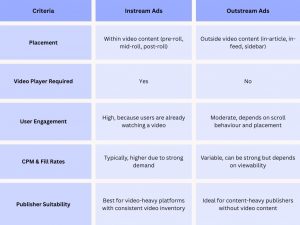
User Experience Differences
In-stream advertising is directly associated with the user’s immersive environment. When users watch video content, they typically anticipate seeing advertisements, which leads them to complete more advertisements and engage more fully with that advertisement than if it were not part of an immersive experience. As users are ready to watch a video that is relevant to their needs, the ad becomes much more contextual and natural for them to view.
Outstream advertising provides flexibility in its placement; however, it also relies on the user scrolling and can potentially be experienced diversely. While some placements may be made in between paragraphs, or in a feed-type method, they will blend into the viewing environment (reading environment) well; however, if they were placed poorly, the user may likely view them as disruptive – particularly if the advertisement suddenly expands. If outstream advertisements are used, it is crucial to implement the proper autoplay behaviour and muted defaults to maintain a conducive user experience.
Revenue Potential
As a rule, instream advertising has a great deal of value because advertisers consider people viewing a video to have a high level of intent. Consequently, instream advertising typically provides very high CPMs due to the combination of the high fill rate and the competitive demand for ads within this category; therefore, they usually represent most of the revenue generated for publishers with established video programs.
On the other hand, outstream advertising provides publishers with a more widely available option for generating income through advertising, and can provide publishers with very good returns if they are able to find an appropriate balance between high viewability and high traffic volume. This type of advertising is beneficial to publishers who want to generate incremental revenue from advertising, but do not have the financial resources to invest heavily into video production. When managed effectively, outstream advertising can increase a publisher’s total ad revenue and/or create increased competition for inventory being offered in ad auctions.
How User Intent & Content Type Influence Performance
The success of ad formats largely depends upon user intent. Users have a high level of intent, concentrated attention, and view the ad relevantly while actively searching for video content, so instream ads work very well. In contrast, outstream ads are best utilised in conjunction with long-form written content, high-scroll environments where frequent visibility is achieved.
Publishers should decide which ad format will yield the maximum amount of revenue based upon a publisher’s specific content strategy, user behaviours, and the technical requirements needed to run the ad. Many publishers can maximise their overall monetization strategy by using a combination of both ad formats to drive revenue.
When Should You Use Instream vs Outstream Ads?
When deciding whether to choose instream or outstream advertisements, Think about the user behaviour, content strategy and reliable inventory available in your marketplace. Each format will perform optimally in different situations, so knowing when to use each will allow the publisher to maximise both their revenue and the end-users’ experience.
Instream ads should be considered for the video-first publishers as well as for any platform that continuously produces and delivers original video content on a consistent basis. This would include OTT Services, Streaming Applications, Educational Platforms, Sports Providers as well as Video Websites such as YouTube and its competitors that users will visit specifically with the intent to watch video. Because users will already have a high level of intent to view, instream advertisements will generally perform better than other ad formats yielding stronger video completion rates and commanding higher CPM rates.
For publishers that feature long-form videos, ongoing upload schedules or a complete dedicated page for video content, instream advertising is probably going to be the best choice. Publishers that can ensure a steady video output pipeline will benefit the most from these high-value advertising spots.
When Outstream Ads Are Ideal
Publishers who do not have original videos should consider outstream ads as an excellent opportunity to monetize their platform with video ads without having any video assets. Sites like blogs, news, product reviews, financial and lifestyle articles, and niche content websites will find outstream to be a comfortable fit within the text-based framework of their site.
Outstream placements work best within a high scroll depth, engaged viewing audience, and long-form content; but they can also be easily set up and customized on either desktop or mobile devices.
Tips for Selecting the Best Format for You
•Assess Your Ad Inventory: Outstream is a great way to monetise your site without the need to produce lots of videos.
•Recognise Your Audience Behaviour: Outstream will appeal to your audience if they scroll a lot, while instream ads will appeal to viewers who love watching videos.
•Think About How Your Page Layout Works: You will require a video player for instream ads, while outstream ads can easily be placed within the text (between paragraphs or in-feed).
•Research Both Formats: Many publishers find that by using both options and tailoring them to each page-type (blog, product, landing pages), they achieve optimal results.
Benefits for Publishers
While there are pros and cons associated with both formats of advertising (instream vs outstream), the way they benefit publishers will differ based on both your Content Strategy and traffic patterns. By understanding these differences, it will help you make informed revenue-generating decisions regarding how you structure your video monetisation.
Instream Ad Benefits
Instream ads typically generate very high CPMs because advertisers view the placement as premium placements that have a higher likelihood of reaching motivated customers (“strong user intent”). Generally, people will pay more attention to an ad that appears during a programme they are actively viewing, and they are much more likely to engage with, and ultimately complete, an ad that is presented during their viewing experience.
Additionally, instream ads provide advertisers greater opportunities for contextual targeting. The fact that instream ads are associated with specific video content allows advertisers the ability to match their creatives to video content that deals with many different types of themes. For example, if you produced a gaming video, an advertiser could match their creative(s) with your video content. It is much more likely that a gamer will engage with a gaming ad than an ad dealing with something else, which improves both advertisers’ and publishers’ ROI. By using instream formats, video-centric publishers will have the opportunity to diversify their revenue streams and become even more valuable as demand from brand advertisers increases and video-based campaigns are launched.
Benefits of Outstream Ads
Outstream ad placements offer a unique opportunity for publishers that don’t currently create any video content to monetize through Video Ads. This greatly benefits publishers of blogs and long form content such as news and information.
Outstream Ads create competition among all ad types (Video and Display) as opposed to simply having a higher price than Display Ads due to the nature of how Outstreams Viewability model works. Outstream Ad placements are activated as the user scrolls down the page. Therefore, they can have a great impact on the fill rate of inventory across multiple platforms.
Outstream Ad placements increase engagement on the page, as well add a dynamic and visually stimulating option for Publishers to create New User Experiences. Instead of creating Video Player Integrations or Producing video themselves to create Dynamic, Engaging Ads, Outstreams enable Publishers to make use of their site (page) to build engagement.
Challenges and Best Practices
While instream and outstream ads offer strong monetisation opportunities, they also come with challenges that publishers need to manage carefully. Issues such as ad fatigue, autoplay restrictions, and maintaining high viewability can impact both user experience and revenue. Overusing video ads, especially outstream units placed too frequently, can lead to user irritation, decreased engagement, and lower session duration. Meanwhile, browsers and mobile operating systems have tightened autoplay rules, which can affect how reliably video ads trigger, especially on mobile devices or slower networks. Viewability is another concern; if ads don’t appear fully on-screen or load too late, publishers may lose impressions and revenue.
Best Practices for Success
To maximise performance, publishers should adopt a thoughtful approach to implementation. For outstream ads, always ensure videos are muted by default to comply with autoplay policies and avoid disrupting readers. Limiting intrusive placements is equally important, avoid stacking multiple outstream units too close together or placing ads in areas where they interrupt the natural reading flow.
Placement and timing matter. Optimise where video ads appear so that they load exactly when the user reaches the relevant section, improving viewability and maintaining a smooth experience.
Finally, work on ad load speed. Faster-loading creatives improve both user satisfaction and ad performance, especially on mobile. Using lazy loading, asynchronous tags, and clean page code can significantly enhance results.
Final Thoughts
Both instream and outstream ads play essential but distinct roles in a strong video monetisation strategy. Instream ads deliver premium performance for publishers with dedicated video content, while outstream ads unlock video revenue for text-heavy and mixed-media websites. Rather than choosing one over the other, smart publishers recognise that each format serves a unique purpose and can contribute to different parts of the user journey.
To maximise results, publishers should actively experiment, A/B test placements, and analyse how each format impacts revenue, engagement, and user experience. Small tweaks in placement, load behaviour, and frequency can make a significant difference in overall performance.
The core takeaway is simple: instream and outstream ads aren’t competitors, they’re complementary tools that, when used together, help publishers unlock more value from their content. With the support of a professional ad management platform like Newor Media, publishers can optimise both formats, improve competition, and build a more resilient and scalable revenue strategy.
FAQ
Q 1: What is the main difference between instream and outstream ads?
Instream ads run within video content, while outstream ads appear in articles or feeds without needing a video player. Each serves different content types and user experiences.
Q 2: Which ad type earns higher revenue for publishers?
Instream ads typically deliver higher CPMs due to strong user intent. Outstream ads, however, offer scalable revenue for publishers without video content.
Q 3: Can I use both instream and outstream ads on the same website?
Yes, many publishers use a hybrid strategy to maximise inventory and fill rates. Mixing both formats provides more opportunities for competition and revenue growth.
Q 4: Do outstream ads negatively affect user experience?
Not when implemented correctly with muted autoplay, proper spacing, and non-intrusive placement. Thoughtful setup ensures they enhance monetisation without disrupting readers.