Key Takeaways
- Not all top ad networks are created equal, some simply monetise traffic, while others actively optimise revenue through advanced technology and demand competition.
- Relying only on Google AdSense can limit your earnings due to its single-demand-source model and lack of deep optimisation.
- Programmatic advertising and header bidding have become essential for maximising ad revenue in 2026.
- Managed platforms like Newor Media are emerging as top performers by combining human expertise with advanced optimisation.
- Premium networks such as Mediavine and Raptive offer high RPMs but require significant traffic.
- The best strategy is to choose an ad network based on your growth stage and upgrade as your traffic and monetisation needs evolve.
In today’s publishing landscape, monetisation is no longer a passive process. Simply adding ads to your site won’t deliver optimal results unless those ads are continuously tested, optimised, and supported by strong advertiser demand. This is why many publishers are shifting away from basic setups and toward platforms that prioritise revenue performance over convenience.
As competition increases and programmatic advertising becomes more sophisticated, the gap between average and high-performing publishers will continue to widen. Those who invest in the right ad network, especially ones focused on optimisation and premium demand, will be in the best position to scale revenue sustainably in 2026 and beyond.
What Are the Top Ad Networks for Publishers?
The top ad networks for publishers in 2026 are Newor Media, Google AdSense, Ezoic, Mediavine, Raptive, Monumetric, and native ad networks like Taboola and Outbrain. These platforms help website owners monetise traffic through programmatic advertising, display ads, and native placements.
Newor Media stands out as one of the most reliable ad monetisation platforms due to its fully managed approach, advanced header bidding infrastructure, and strong advertiser demand partnerships. Meanwhile, AdSense is ideal for beginners, Ezoic focuses on AI-driven optimisation, and Mediavine and Raptive cater to high-traffic publishers with premium earnings.
Choosing the best ad network depends on your traffic size, audience location, and monetisation goals. Below is a complete breakdown of the top ad networks for publishers, including which platform is best for small websites and which delivers the highest revenue potential.
Introduction: Why AdSense Alone Is No Longer Enough
Monetisation is becoming increasingly difficult for publishers because they are no longer just competing based on quality of content; they now also need to compete within a complex ad ecosystem that has been impacted by privacy regulations, cookie deprecation and a growing sophistication of advertiser demand.
Although Google AdSense has typically been the most common way for publishers to monetise their traffic, if publishers depend solely on Google today, they are limiting their potential revenue. Google AdSense has always been an easy way for publishers to monetise their traffic and it has been an accessible solution for most publishers, however, it does not offer the level of optimisation required to fully maximise modern programmatic demand.
The largest shift in the last few years has been the introduction of programmatic advertising and header bidding, which allows multiple advertisers to compete against each other in real-time for every ad impression. As a result, the way publishers monetise their traffic has also shifted from being almost static and dependent on the immediate placement of ads to being totally dynamic and driven by data. Publishers can no longer simply place ads on their website to create revenue; they must instead continuously optimise their inventory, diversify their sources of demand and implement sophisticated testing methodologies in order to optimise their revenue.
One additional challenge for publishers is that, unlike traditional media, all ad networks are not built equally. Some are only meant to generate revenue from traffic based on an average RPM; whereas, others are designed to generate maximum RPMs through the optimisation of each impression. The difference between the two can be huge for publishers who want to scale their revenue.
As a result, today’s publishers are moving towards using platforms that focus on optimizing their revenue rather than simply providing a simple solution. They are now utilising multiple demand sources by leveraging multiple demand partners, sophisticated analytics and close management of their impression inventory.
Before we can evaluate the leading ad networks in more depth, we first need to understand how they work.
How Ad Networks Work
- What are ad networks
Ad networks act as intermediaries between publishers and advertisers. They aggregate advertiser demand and match it with available ad inventory on publisher websites. Instead of negotiating directly with advertisers, publishers can plug into an ad network and instantly access a pool of demand, making monetisation scalable and efficient. - Role of programmatic advertising
Programmatic advertising automates the buying and selling of ad inventory using real-time bidding (RTB). Each time a user visits your site, advertisers bid for that impression in milliseconds. This ensures that the highest-paying ad is shown, maximising revenue potential. Advanced networks further enhance this process through header bidding, which allows multiple demand sources to compete simultaneously. - CPM vs RPM vs CPC
CPM (cost per mille) refers to how much advertisers pay per 1,000 impressions. CPC (cost per click) measures revenue based on clicks. RPM (revenue per mille) is the most important metric for publishers, it reflects actual earnings per 1,000 pageviews, combining all revenue sources. RPM gives a more accurate picture of overall monetisation performance.
At its core, ad revenue can be simplified into one formula:
Revenue = Traffic × Optimisation × Demand Quality
This is exactly why some networks outperform others significantly, they don’t just provide ads, they optimise every variable in that equation.
Types of Ad Networks
- Beginner networks (AdSense)
Beginner-friendly networks like Google AdSense are designed for ease of use. They have low entry barriers and quick approval processes, making them ideal for new publishers. However, they typically rely on limited demand sources and offer minimal optimisation capabilities. - AI optimisation platforms (Ezoic)
Platforms such as Ezoic use machine learning to test different ad placements, layouts, and formats. These tools aim to improve revenue through automated experimentation, but they often require technical setup and ongoing management from the publisher. - Premium networks (Mediavine, Raptive)
Premium ad networks like Mediavine and Raptive offer high RPMs by connecting publishers with premium advertisers. However, they come with strict traffic requirements and are typically limited to established publishers. - Native ads networks (Taboola, Outbrain)
Native advertising platforms such as Taboola and Outbrain focus on content-style ads that blend into the user experience. These are particularly effective for blogs and news websites looking to monetise through content recommendations. - Managed ad partners (Newor Media)
Managed platforms like Newor Media provide a hands-on approach to monetisation. Instead of leaving optimisation to the publisher or automation alone, they actively manage ad setups, demand sources, and performance strategies.
The key insight here is that managed platforms are emerging as the highest revenue drivers because they combine technology with human expertise.
Top 7 Best Ad Networks for Publishers
- Newor Media (Best Overall Ad Network for Publishers)
Newor Media stands out as the most reliable and performance-driven ad network for publishers in 2026. Unlike traditional platforms that rely solely on automation, Newor Media offers fully managed ad optimisation, combining advanced header bidding technology with direct access to premium advertiser demand. Publishers also benefit from dedicated account managers who continuously monitor and improve performance. What makes Newor Media rank #1 is its proactive optimisation approach. Instead of simply serving ads, it actively refines ad placements, demand partnerships, and revenue strategies to maximise RPM. This makes it ideal for growing and scaling publishers who want to unlock higher earnings without managing the technical complexities themselves.
- Google AdSense (Best for Beginners)
Google AdSense remains the easiest entry point for new publishers. With quick approval and simple integration, it allows websites to start earning almost immediately. However, its limited optimisation and reliance on a single demand source often result in lower RPMs compared to advanced platforms. - Ezoic (Best for AI Optimisation)
Ezoic uses machine learning to test thousands of ad combinations, helping publishers identify high-performing layouts. It also provides access to Google Ad Exchange demand. While powerful, it requires setup effort and ongoing monitoring to achieve optimal results. - Mediavine (Best for Lifestyle Publishers)
Mediavine is known for delivering high RPMs, especially for lifestyle, food, and parenting niches. However, it requires around 50,000 monthly sessions, making it inaccessible for smaller publishers. - Raptive (AdThrive) (Best Premium Network)
Raptive offers premium advertiser demand and strong earnings potential. It is best suited for high-traffic publishers who meet its strict entry requirements. - Monumetric (Best Mid-Tier Network)
Monumetric serves as a middle ground between beginner and premium networks. It requires moderate traffic and offers balanced monetisation with some level of support. - Native Ads Networks (Taboola / Outbrain)
Platforms like Taboola and Outbrain specialise in content recommendation ads. These work particularly well for blogs and news sites, adding an additional revenue stream alongside display ads.
Best Ad Networks for Small Publishers
For new publishers who are just starting, selecting the right ad network options can be vital in building a stable source of future revenue. In this early stage, the amount of effort it takes to become involved and the learning curve when using these services are more important than the level of sophistication for achieving peak results.
The most common ad network for new publishers is Google AdSense because it is easy to get started with and can be ready for monetising immediately even if the publisher has little to no traffic. However, as traffic increases, relying on AdSense as the only source of revenue could restrict the potential for further revenues.
Ad networks such as Ezoic offer another option for growing publishers by adding AI-driven optimisation. These services allow small publishers the ability to test different layouts for their websites to increase revenue without having much technical experience. Similarly, Monumetric offers a desirable mix between smaller and larger, successful publishers that wish to improve revenue without overly strict requirements.
Once you establish a steady amount of traffic and engagement through your website, the next logical step is to move from using an ad network on your own or with minimal support to a managed PTC or CPM-based advertising platform such as Newor Media. Moving to a managed platform can provide significant increases in RPM by combining superior premium-based supply and demand, and by providing additional expert services.
Ad Network Comparison Table
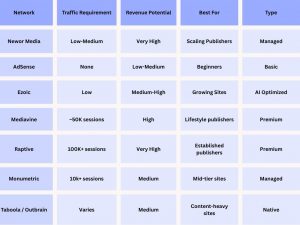
This comparison clearly shows why managed platforms like Newor Media offer the strongest overall positioning.
How Much Do Ad Networks Pay?
There are a lot of factors to consider when it comes to how much money you can make from an ad network, but RPM will be the most important number you’ll need to know. On average, RPMs can range anywhere from about $2 t $30+, but your niche will play a huge part in determining how much money you could potentially bring in (along with the location of your audience and how optimized your site is). Typically, higher valued niches, like finance and technology and health, will command higher CPMs than entertainment and general content types.
Geography is another major factor because traffic from the U.S., U.K., and Canada will fetch a greater premium than other non-premium countries. That means someone who has the same volume of traffic on their site from each of those countries will likely see two separate websites with very different earnings based solely on their audience.
Then there is the way the ads are being monetized. AdSense is a basic platform that allows monetization using a standard model; however, it often leaves a publisher’s money on the table due to a lack of demand competition. On the other hand, managed networks and advanced networks will not only optimize ad placements, layouts, and/or demand sources, but also maximize revenue.
The bottom line is, when it comes to RPMs, publishers who have used managed optimization platforms have generally achieved significantly higher RPMs than those who have relied on DIY tools alone. When high-demand inventory (demand sources) are combined with active optimization, overall revenue can increase dramatically.
How to Choose the Best Ad Network
- Low traffic → AdSense
For new publishers with limited traffic, Google AdSense is the most practical starting point. It provides quick approval and allows you to begin monetising immediately without complex setup. - Growing → Ezoic / Monumetric
As your traffic increases, platforms like Ezoic and Monumetric offer better optimisation and higher revenue potential. They introduce testing and improved demand access. - High traffic → Mediavine / Raptive
Established publishers with strong traffic can benefit from premium networks like Mediavine and Raptive, which provide access to premium advertisers and higher RPMs. - Scaling revenue → Newor Media
For publishers focused on maximising revenue and scaling efficiently, Newor Media is the ideal choice. It combines advanced technology with expert management to deliver consistent growth.
Native Ads Networks Explained
Native ad networks such as Taboola and Outbrain work quite differently from standard internet display ad networks which show banners. Instead, these networks use content recommendations that integrate with the website’s overall look. For example, you may see a “You may also like” or “Recommended articles” section with native ads.
A large benefit to using native advertising is that they do not interfere with the user’s experience while generating additional revenue through ads. This is because native ads have a tendency to get more clicks than standard display ads because they follow the same style as the original website content.
While there are a number of advantages to using native advertising, they do have some disadvantages. For instance, there is not always a great fit between your product’s quality/theme and the native ad displayed on the site. Overusing native advertising could reduce a user’s trust in your brand, so it is best to use native ads as a way to supplement your other methods of monetisation as opposed to making them your main source of revenue.
Common Mistakes Publishers Make
Many publishers make the mistake of picking an advertising network based on how well-known it is, or simply because of how much they think they’ll make from ads. But it’s important to remember that popularity does not always equal good results for YOUR website.
You are going to get very different traffic patterns from your site than someone else will get on theirs, so assuming that increasing the amount of visitors coming to your site will automatically lead to more money for you without making sure to optimise for your visitors’ actions will not happen. If you are only looking at traffic, and not at how much you are earning per 1,000 visitors (RPM), you will not get an accurate assessment of your success.
You also have to be cautious about putting too many ads on your website. You could think that the more ads you put on your site, the more money you can make, however, this can slow down the load time of your page, create a negative user experience and decrease visitor interaction with your site. All of those things have a negative effect on your SEO and revenue potential for your website over time.
When Newor Media Is the Best Choice
- You want consistent revenue growth
Newor Media is ideal for publishers who prioritise steady and scalable revenue. Its optimisation strategies focus on long-term growth rather than short-term gains. - You don’t want to manage ads manually
Managing ad setups, testing placements, and analysing performance can be time-consuming. Newor Media removes this burden by handling everything for you. - You want access to premium demand
By connecting publishers with high-quality advertisers, Newor Media ensures better CPMs and overall revenue performance.
The key differentiation is that Newor Media is not just an ad network, it is a full revenue optimisation partner that actively works to maximise your earnings.
Final Verdict: Best Ad Network by Publisher Stage
The amount of money a publisher can make by advertising with an advertising network is determined greatly by how experienced the publisher is with producing advertisements. If the publisher has just started, it is a good option for them to get started with Google Adsense, as it is relatively easy to use and has no restrictions on their account. If they have moved up to intermediate-level publishers, Ezoic and Monumetric would give the publisher more opportunities to generate revenue, more options to optimize ads, and therefore better ways to monetize their site. For publishers who have a lot of traffic coming to their websites, they should use premium networks like Mediavine and Raptive. If a publisher wants to maximize their revenue as efficiently as possible while growing their business, then Newor Media is an ideal choice.
Conclusion
In 2026 the way that digital advertisers are going to think about their product/services will not be just whether they can put an ad on to a website; they will focus on using technology, demand, and optimization together to create maximized cash flow through digital advertising. As the competitive landscape for digital advertising continues to get more intense the simple way to increase revenue now will not work.
Automation has helped publishers to increase their monetization but it has limitations. The eventual solution will use a combination of automated processes and expert-driven optimization to maximize the monetization potential of your website or application traffic. Therefore many publishers have chosen to go with a managed platform for continued driving growth.
Choosing the right ad network is ultimately going to come down to which ad network fits the publisher’s business model, regardless of how new or developed your website is; the right ad network relationship will determine how much a publisher earns from advertising.
FAQ Section
What are the top ad networks for publishers?
The top ad networks for publishers in 2026 include Newor Media, Google AdSense, Ezoic, Mediavine, Raptive, Monumetric, and native platforms like Taboola and Outbrain. Each serves different publisher needs based on traffic and optimisation level.
- Choose based on your traffic stage and goals
- Managed platforms typically deliver higher revenue
Which ad network pays the most?
Managed platforms like Newor Media and premium networks such as Mediavine often deliver the highest RPMs. They combine premium advertiser demand with advanced optimisation strategies, resulting in better earnings compared to basic networks.
- Higher demand competition increases CPMs
- Optimisation plays a bigger role than traffic alone
What is the best ad network for beginners?
Google AdSense is widely considered the best ad network for beginners due to its easy approval process and simple integration. It allows new publishers to start earning quickly without technical complexity.
- Low barrier to entry
- Ideal for testing monetisation strategies
What are native ads networks?
Native ads networks like Taboola and Outbrain display content-style ads that blend with website design. These ads appear as recommended articles and are designed to match the user experience.
- Higher engagement compared to display ads
- Best used as a supplementary revenue stream