What Is vCPM?
Viewable Cost per Mille (vCPM) is a key component of how advertisers prices their ads. Advertisers are measured on the number of viewable impressions (not just served impressions), i.e., number of views that meet the “viewable” criteria. A viewable impression is defined as an ad that is at least 50% visible on the user’s screen and has been on the user’s screen for at least a predetermined minimum amount of time. This contrasts with the traditional CPM method, which counts all ads served, regardless of whether there was an opportunity for the user to see them. Therefore, vCPM provides a more meaningful representation of the ad’s visibility, user engagement, and value. In addition, increasing vCPM for publishers means they can provide better ad viewability and user experience and attract better-quality advertisers. This document will describe the definition of vCPM, how it is calculated and how the definition of vCPM differs from CPM, why vCPM is important for publishers and sustained methods for increasing vCPM.
Introduction: Why Viewability Now Defines Ad Performance
Over the last 10 years, the digital advertising marketplace has seen tremendous changes in how the industry serves its clients. Advertisers have changed what they consider a success from only being volume-based and are now concerned if their ads are actually “seen”. The focus on viewability has become one of the baseline measurements of ad performance, thus changing the way that publishers will approach inventory and revenue strategies. The decrease in demand for low-viewability impressions by advertisers has led to an increase in the publishers and advertisers’ expectations of the advertisers’ return-on-investment (ROI) levels. When a publisher consistently provides low-viewability impressions, it often leads to lower bids for their products, a loss of trust between the advertisers and publishers, and ultimately an overall decrease in ad revenues. To combat this trend, the advertising industry is utilizing metrics that reward visibility vs. just delivery.
You should become familiar with vCPM, which stands for “viewable cost per thousand impressions”. This metric is unique because it focuses on tangible visibility rather than simply counting impressions served as is the case with CPM. With vCPM advertisers only pay for impressions that can be viewed, so publishers should look to use vCPM to improve their ad placement strategies and increase audience interaction, engagement, and ultimately generate more revenue from high quality and viewable impressions. As you read through this guide, you’ll discover the key components of vCPM including its definition, calculation process, and relationship with the traditional CPM model. You’ll also learn what makes vCPM a key indicator for digital advertising success, as well as how to implement best practices to increase viewable impressions to maximise revenue. By the end of this guide, you’ll understand how the concept of view-able/visibility will change the way that you view your monetization strategy, and understand why it will be
at the forefront of the future of digital advertising. Publishers are encouraged to take advantage of professional ad management networks like NeworMedia; By doing this, they can dramatically improve their viewability rates through improved advertising placements.
What Is vCPM?
vCPM, or Viewable Cost per Mille, is a digital advertising metric that calculates the cost advertisers pay for every 1,000 viewable impressions, rather than all impressions served. Unlike traditional CPM, which charges advertisers for every ad that loads on a page-regardless of whether users see it-vCPM ensures that payment is tied directly to the ads’ visibility. This makes it a more accurate reflection of an ad’s real value.
What Counts as a Viewable Impression?
Viewability is standardized by the Interactive Advertising Bureau (IAB), which defines minimum thresholds for an impression to be considered “viewable”:
- Display ads: At least 50% of the pixels must be visible on screen for 1 second or more.
- Video ads: At least 50% of the pixels must be visible for 2 seconds or more.
These thresholds ensure that advertisers only pay for impressions with a genuine chance of being noticed, rather than for ads that load off-screen or scroll past too quickly.
Why vCPM Exists
Advertisers are wasting their money on a lot of digital ads that are not even seen by users. Ads that are below the fold or loading slowly offer some value to advertisers, but do not provide meaningful exposure to the advertising message. The value of viewed impressions (vCPM) provides a solution to this issue and aligns advertisers’ dollars with meaningful impressions. The advertiser is only paying for impressions that are viewable, meaning the greatest possible ROI can be achieved, while the publisher is giving advertisers a way to clearly understand the quality of its inventory.
Why Publishers Should Care
At this point in time, for publishers to be successful in generating revenue; viewable impressions should no longer be an option, but rather the primary focus of their monetization efforts. In addition to generating increased advertiser demand for viewable inventory (resulting in higher vCPM), publishers will find that they can provide their advertisers with value-added products and services (thereby developing strong relationships). Furthermore, publishers will gain the ability to develop stronger monetization strategies through providing value-added impressions that ultimately enable advertisers to convert. As a result of using viewable impressions, vCPM will act as the bridge connecting delivered impressions to genuine user engagement, resulting in a situation in which publishers earn a return on investment for all their delivered impressions, while advertisers pay for only those impressions that are meaningful to them.
vCPM Formula Explained
Understanding vCPM requires knowing not just what it measures, but how it’s calculated. The formula is simple and straightforward:
vCPM = (Total Ad Spend/Viewable Impressions) * 1000
This formula calculates the cost advertisers pay for every 1,000 viewable impressions, focusing only on ads that meet viewability standards.
Example Calculation:
- Total ad spend: $200
- Viewable impressions: 50,000
vCPM = (200/50,000)* 1000 = 4
In this case, the advertiser is effectively paying $4 for every 1,000 impressions that were seen, rather than all impressions served.
How This Differs from CPM
Traditional CPM (Cost per Mille) counts all served impressions, regardless of whether users saw the ad. This means advertisers may end up paying for impressions that never deliver real exposure. In contrast, vCPM considers only viewable impressions, providing a more accurate measure of an ad’s true performance.
Why the vCPM Formula Matters
For publishers, this formula is more than just math-it’s a guideline for revenue optimization. By focusing on viewable impressions, publishers are incentivized to place ads in high-visibility locations, improve site layout, and enhance user experience. This approach not only rewards quality placements but also ensures that ad revenue aligns with actual user attention.
Ultimately, the vCPM formula reinforces the shift in digital advertising from quantity to quality. It encourages publishers to prioritize meaningful engagement over sheer impression volume, creating a better ecosystem for both advertisers and users.
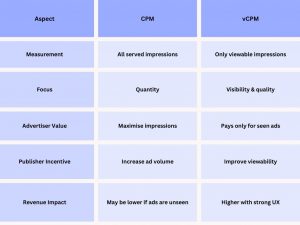
vCPM vs CPM: Key Differences Explained
Understanding the distinction between vCPM and CPM is crucial for publishers aiming to optimize revenue and deliver value to advertisers. While both metrics measure ad costs per thousand impressions, they differ fundamentally in focus, measurement, and incentive structures.
Why Advertisers Prefer vCPM
Advertisers are gradually transitioning to using vCPM rather than other CPMs due to improved ROI. Advertisers pay only for those impressions that comply with viewability standards; thus, it decreases wastage of their advertising budget on impressions that viewers do not observe. Additionally, advertisers can engage with their audiences more effectively, as users have a higher propensity to engage with (click-through, convert, develop awareness of) viewable advertisement content than invisible content. Therefore, vCPM has aligned the cost of advertising with the meaningful exposure of advertisements, therefore allowing for increased efficiencies in advertising and measurable results for advertising campaigns.
Why Publishers Benefit Too
Publishers can take advantage of viewable impressions (vCPM) to strategically position ads and enhance the user experience. By having a high viewability rate, advertisers can build trust and have access to better quality advertising demand, while more money is paid per thousand impressions. Publishers will be rewarded for sending quality traffic to the advertisers rather than just serving the greatest number of ads possible. Over time, publishers that focus on delivering viewable impressions will create a more sustainable ad ecosystem that benefits both sides by enabling genuine user engagement rather than inflated impression counts.
On the other hand, the cost per mill (CPM) model focuses on delivering more impressions than creating higher-quality impressions. Maximizing the number of ad impressions may seem easier than maximizing viewable impressions; however, a large percentage of these will be above the fold (invisible), and/or will be viewed only for a second before being scrolled down. Consequently, advertisers receive little value from this type of advertising, resulting in lower revenues, weaker advertiser relations, and lost opportunities to optimize visibility.
Thus, the shift from a CPM model to a vCPM model is indicative of the trends in the digital advertising industry that are moving towards performance-based and viewable impressions. With a better understanding of how to optimize for vCPM, publishers can increase their revenue and help provide a more transparent and efficient advertising ecosystem.
Why vCPM Matters for Publishers
For publishers, vCPM is more than just a metric-it’s a direct indicator of inventory quality and a driver of both revenue and advertiser demand. By focusing on viewable impressions, publishers can unlock multiple benefits that go beyond simple ad placement.
Direct Revenue Impact
The increased revenue generated by high vCPM is perhaps one of the most noteworthy benefits. Advertisers are prepared to pay a higher price for ad impressions that reach their intended audience (i.e. seen by users), thus resulting in better bids for ad placements that meet this standard. Due to the greater number of potential customers that may be present when ads are visible, and because premium buyers often set minimum viewability requirements, premium buyers will seek to purchase ads at higher rates when they are visible. By optimizing for vCPM, publishers can obtain better rates and more efficiently monetize their ad inventories.
Demand & Reputation Benefits
In addition to generating revenue, an effective vCPM increases the demand for advertisers and the reputation of publishers. It is only natural for advertisers to prefer partnering with publishers that consistently provide viewable ads. Publishers with high-quality vCPMs are better positioned to acquire private marketplace (PMP) deals, negotiate better when negotiating directly with advertisers, and foster healthy relationships built on long-term trust. Through his or her high-quality viewable inventory, a publisher can position himself or herself as a trusted and reliable partner in an increasingly competitive advertising landscape.
Real-World Insight
Consider a publisher whose ad inventory has an 80% viewability rate. Compared to a publisher with just 50–55% viewability, the higher-performing publisher often earns 20–30% higher CPMs, highlighting how directly viewability influences revenue. This demonstrates that vCPM isn’t merely a technical metric-it’s a signal to advertisers that the inventory they are buying is effective and engaging.
Key Takeaway
Through vCPM, an advertiser pays for the visibility of their ad, whereas, a publisher receives a reward for providing quality and not just for merely serving an impression. For a publisher, optimizing to serve only viewable impressions is necessary if he wants to maximize revenue, gain premium demand, and develop long-term relationships with advertisers.
Using vCPM allows publishers to turn their inventory of standard impressions into a much more profitable, viewable, high-value inventory of Viewable Opportunities.
Factors That Affect vCPM
When it comes to maximising vCPM, there are many things that determine the number of viewable impressions a publisher receives. Even though there are variables that have no impact on publishers like advertiser demand, the following most significant factors play a key role in maximising a publisher’s revenue and overall visibility.
- Placement of Ads:
The placement of your ads directly impacts vCPM. The higher the position of an ad, the higher the likelihood it will be viewed. Ads that require scrolling down below the fold will generally have less visibility compared to ads placed above the fold. Also, scroll depth and time spent are very important when it comes to vCPM. If an ad is viewed for too short a period or doesn’t have enough depth of scroll before it disappears completely, it only provides minimal value to the vCPM. To help increase vCPM, strategic ad placement(s) will help publishers obtain a higher percentage of served impressions that become viewable.
- Ad Types:
Different types of ads will have very different impacts on viewability as well. Larger ad sizes, like leaderboard banners or rich media units, often have a much greater impact than smaller banners. Ads that maintain their position while users scroll (i.e., sticky/anchored ads) will generally increase the number of viewable impressions. Ads with video content and interactive capabilities typically have higher levels of engagement due to their movement and interactivity. When trying to maximise vCPM, it’s vital publishers select the ad formats that have the best chance of capturing users’ attention.
- Page Speed
The time taken by a webpage to load affects an ad’s visibility. Many mobile users often leave the page quicker than other users and this quicker abandonment may cause ads not to be delivered when they are supposed to be at or above the viewable threshold level. Page speed optimization creates an environment where ad content is delivered more promptly, thereby increasing the probability the ad(s) will be viewed. - User Experience (UX)
If the design of a website is cluttered with too many ads; it may adversely affect user engagement by preventing people from seeing the advertisements they’re provided with. Having a clearly laid out and easy to navigate site will improve scrolling habits and focus which will cause more impressions to count as viewable. - Device Type
Different devices behave differently. Mobile users often scroll faster and interact differently than desktop users. Ensuring responsive ad placement that adapts to various screen sizes can prevent missed impressions and improve overall vCPM.
By mastering these factors, the publisher will not only be able to increase both the quality and visibility of their inventory, but also their overall vCPM by optimizing ad viewability, ad format, page speed, user experience (UX), and device responsiveness. All these components are significant keys to building relationships with advertisers while increasing the opportunity for premium advertiser and higher revenue for the publisher.
How to Increase vCPM
Optimizing vCPM requires a combination of smart ad placement, site performance improvements, and user-centric strategies. By focusing on viewable impressions rather than sheer volume, publishers can boost revenue while enhancing advertiser satisfaction. Here are actionable strategies to increase vCPM:
- Ad Optimisation for Placement
The placement of advertisements is an important aspect of Viewable Impression Index. It is important to select placement in High Engagement Zones (HEZs) where users are likely to view them. Therefore, this means that advertisers should place ads as close to the top of a page as possible or in areas with long dwell times. Avoid placing ads at the bottom of content or in any location where users have likely scrolled quickly past without seeing them. By considering placement carefully, more impressions will be considered viewability-compliant and therefore increase vCPM by increasing the number of impressions available for advertisers.
- Lazy Loading of Ads
Lazy load is a form of display advertising that allows an ad to load when it has a high probability of being seen by a viewer. Lazy loading eliminates wasted impressions by ensuring that an ad does not load if, at the time of loading, it is in the “below-the-fold” position of a page to where it has not gained views yet. In addition, lazy loading allows an ad to render (load) quickly increasing the likelihood of an impression being viewable and enhancing user experience.
- Increase Site Speed to Increase vCPM
There is a direct correlation between Page Load Times (PLT) and viewability. Pages that render pages faster will render advertisements faster thus increasing the viewability of ads. As a result, mobile users frequently navigate quickly between websites and if a page takes too long to load, they will typically leave the page before seeing any ads. Therefore, to increase site speed, it is essential to optimise images, scripts, and implement caching techniques.
- Focus on the mobile user experience
As mobile traffic continues to outpace web traffic on most websites, utilizing a responsive website layout along with mobile friendly ad formats is important for ad viewing. Mobile friendly ads should be displayed in a format that will work across multiple dimensions of mobile devices and in ways that do not interfere with or distract from the user’s experience while using the mobile device. By having a mobile optimally designed website experience, users will continue to be engaged with your brand and as such, the ads displayed on your site will continue to be visible for longer periods of time.
- Smart ad refreshing
Many advertisers believe that refreshing an ad will inevitably lead to more ad impressions. However, if not done in a carefully controlled manner, refreshing ads too many times may annoy the user. You should implement ad refreshing only during in-view times and avoid excessive refresh rates. Implementing these techniques will increase your total time in views while also keeping your total vCPM high.
- Test sticky (anchor) ads
Sticky or anchor ads remain visible while the user scrolls the web page and therefore will have increased time in view. However, if not tested in a thoughtful manner, sticky or anchor ads may have a negative impact on user experience. Therefore, while you want to maximise the number of times the ad is visible you must also balance comfort and don’t create an intrusive user experience.
- Utilising header bidding
Header bidding is a method by which the demand for your inventory increases by allowing multiple advertisers to compete for your inventory. The competition among advertisers creates more opportunities to have higher bids placed on top-performing placements. By increasing access to high-demand inventory from multiple advertisers, you will also increase the number of vCPM rates you receive.
By combining these strategies, publishers can maximize the value of their inventory, improve user engagement, and ensure that every viewable impression contributes meaningfully to revenue. Optimizing vCPM is no longer optional-it’s a critical step toward sustainable, high-performing digital advertising.
Measuring and Tracking vCPM Performance
Effectively measuring and tracking vCPM is essential for publishers aiming to optimize revenue and improve inventory quality. Without reliable data, it’s impossible to know which ad placements are performing well and which need adjustment.
Tools for Measurement
Several tools allow publishers to monitor viewability and calculate vCPM accurately:
- Google Ad Manager Viewability Reports: Offers detailed insights on how much of your inventory meets viewability standards.
- Moat Analytics: Tracks impression quality and engagement, helping identify underperforming ads.
- Integral Ad Science (IAS): Provides independent verification of ad viewability and fraud detection.
- DoubleVerify: Measures ad visibility across devices and platforms, giving actionable intelligence to optimize placements.
Benchmarks for vCPM
Understanding benchmarks helps publishers gauge performance:
- 60–70% viewability: Considered average performance for most inventory.
- 80%+ viewability: Represents excellent performance and often commands higher vCPM rates.
Why Measurement Matters
When it comes to vCPM Tracking (Cost Per Thousand Impressions), it’s not only about tracking the metrics; it’s about understanding how those metrics inform strategic decisions. By looking at what placements are performing best, a publisher can distribute their inventory so they can generate more viewability (i.e., gain more impressions), plus using the metrics available to measure through devices and ad formats (Standard Desktop vs. Mobile) allows them the opportunity to ensure their Desktop and Mobile design allows for maximum viewability.
When you remove or reposition low-performing placements or placements that do not generate views, you have prevented “wasted” impressions and you will ultimately increase your overall monetization.
Regularly reviewing vCPM Tracking will allow the publisher to analyse the data, see the results, and use that information to optimize the Advertising on the given Inventory. Also, with the proper tools and understanding of the benchmark, the publisher can utilize Viewability to establish a substantial competitive advantage and maximize the value of their advertising dollars by providing advertisers with the most visible, engaging, and relevant inventory.
Real-World Example: How vCPM Improvement Drives Revenue
An example is provided to illustrate how vCPM impacted a publisher’s overall ad revenue potential based on their overall average viewability rate. After identifying that the overall viewability rate for their ads was approximately 55%, the publisher acted by making strategic changes to improve the visibility of ads through layout optimization and site speed improvements. They moved ads into high engagement zones, reduced clutter in the layout, and optimized images and scripts for faster loading times, resulting in an increase in the overall viewable rate from 55% to 75% and converting many previously invisible impressions into visible and valuable impressions. As a direct result of these strategic changes, vCPM increased from $3.50 to $6.20, without increasing the total volume of traffic to the site, simply by making the impressions that the publisher was generating more visible and valuable.
The above example demonstrates an important insight for publishers: that small adjustments made to a user’s experience (UX) or where an ad appears can lead to large increases in the amount of revenue generated by that publisher. By optimizing based on viewable impressions, a publisher can increase both their vCPM and develop better relationships with advertisers, who will now see the tangible benefit of every impression they purchase.
This example illustrates how important it is to have strategies focused on viewability. By investing in improvements to layout, speed, and where they place their ads, publishers can generate the maximum amount of revenue and ad performance, while also staying competitive in the digital marketplace of programmatic and display advertising. vCPM in this space represents a metric but also serves as a lever that directly impacts profitability.
The Future of vCPM in Programmatic Advertising
The world of digital advertising is constantly changing, and the use of vCPM will be a bigger part of the programmatic ad landscape as we continue to see these changes take place. The focus has now shifted from the number of impressions an advertiser receives, to the attention users give their ads and to other metrics that are measurable, such as engagement. Viewability and how that impacts an ad’s performance has now emerged as a key performance indicator for all advertisers.
Market Trends
As the market for programmatic advertising has shifted, the focus on viewable impressions has become more prominent. As a result, advertisers are now opting to pay a premium for those impressions because they guarantee they will be seen by the target audience. In addition, many of the newer artificial intelligence (AI)-based bidding models are incorporating signals of viewability when determining how much to invest, allowing for a higher return on investment by ensuring that the ad is garnering user attention. The change toward focusing on viewability reflects a broader shift within the marketplace from caring about how many impressions were delivered to how well the ad was engaged with, with the intention of providing a tangible return for advertisers.
What’s Next for vCPM
It is projected that in the future, attention metrics will be combined with vCPM which will provide advertisers with even more detailed insights into how users are interacting with their ads. Performance-based pricing models that incorporate the metrics of engagement, viewability and conversion are expected to be prevalent, providing advertisers with a closer connection between the cost of their ad(s) and their ultimate outcome. In a privacy-centric environment where cookie-based targeting will be limited, vCPM is seen as a viable option for measuring the effectiveness of an ad without depending on invasive tracking practices.
Publishers are faced with the requirement to adapt to these evolving changes. In addition to increasing immediate revenue from ad placements, optimizing for viewability today also helps prepare inventory for future marketplace demands that reward measurable engagement through programmatic means. As advertisers are increasingly focused on visibility, relevance and return on investment, those who embrace vCPM and attention-based approaches will be positioned to thrive in a future where programmatic advertising will be held accountable and will perform at a high level.
Final Thoughts
VCPM represents the most important metric for success in the digital advertising landscape today; it measures how visible an advertisement is to actual consumers. It does not measure impressions simply based on their numbers, but instead rewards publishers and advertisers for delivering content to users through views (meaning the ads will be seen when the user visits the page). At the same time, it allows publishers to understand why providing higher-quality ad inventory that generates engagement is more beneficial than just maximising the number of ads available.
Providing a quality user experience (UX) and focusing on viewability are essential for building a business on a sustainable revenue model. Publishers who enhance their website layouts, increase their page loading speed, and strategically position their advertisements can see a significant rise in vCPM due to increased amounts of premium demand and strong relationships with advertisers. Focusing on delivering viewable impressions creates a sustainable monetization platform for publishers because the revenue generated aligns with actual engagement rather than just the number of ad impressions delivered.
The long-term growth of sustainable advertising revenue is dependent on delivering high-quality ad impressions rather than high-volume. Investing time and resources to improve vCPM creates a long-term trust between the publisher and its users, boosts engagement, and increases publisher revenue on a consistent basis. Publishers who adopt viewability-driven strategies will be able to remain competitive, continue to provide users with valuable and relevant ad experiences, and prepare themselves for future success in an evolving programmatic ecosystem. Publishers can partner with a professional advertising management network, such as NeworMedia, to develop viewability-driven strategies and achieve consistent vCPM and revenue increases.
Frequently Asked Questions
Q1: What is Viewable CPM?
A: Viewable CPM refers to the Viewable Cost per Thousand (CPM). Viewable CPM is the fee that advertisers pay per 1,000 impressions delivered to a user when those impressions are viewable, rather than all impressions delivered. This metric allows advertisers to only pay for impressions that deliver real value (i.e. impressions delivered to users are seen, not just over-delivered).
Q2: What is the difference between Viewable CPM and CPM?
A: CPM measures the cost of all ad impressions delivered. Viewable CPM is important as it only measures the cost of “viewable” impressions (i.e. either ads that were in view or ads that the user scrolled past quickly). Therefore, Viewable CPM provides a better indication of how effective and valuable an ad is.
Q3: What are good Viewable CPM rates?
A: Viewable CPM rates vary depending on the ad format and audience; generally, for display, $5+ and for video, $10+ see good rates. Both Display and Video Viewable CPM rates improve as Viewability, placement at the top of a webpage, and audience engagement increase.
Q4: What are some ways to increase Viewable CPM for publishers?
A: Publishers can improve Viewable CPM by optimizing ad placement (above the fold and in high engagement areas), optimizing page load speed, creating responsive and mobile-friendly layouts, creating “lazy-load” (ads loading after the user scrolls) layouts, testing “sticky” or “anchor” ads, and using header bidding to increase competition and the demand for inventory.
Q5: Do advertisers prefer vCPM?
Advertisers are interested in using the “viewable Cost Per Mille” (vCPM) metric. This is because it allows advertisers to align their spending with what they can see, which reduces waste and increases ROI (return on investment). Furthermore, high-viewability inventory drives higher engagement rates and better performance in each campaign, making publishers with a lot of high-viewability inventory very desirable partners for advertisers.
One Comment
Comments are closed